
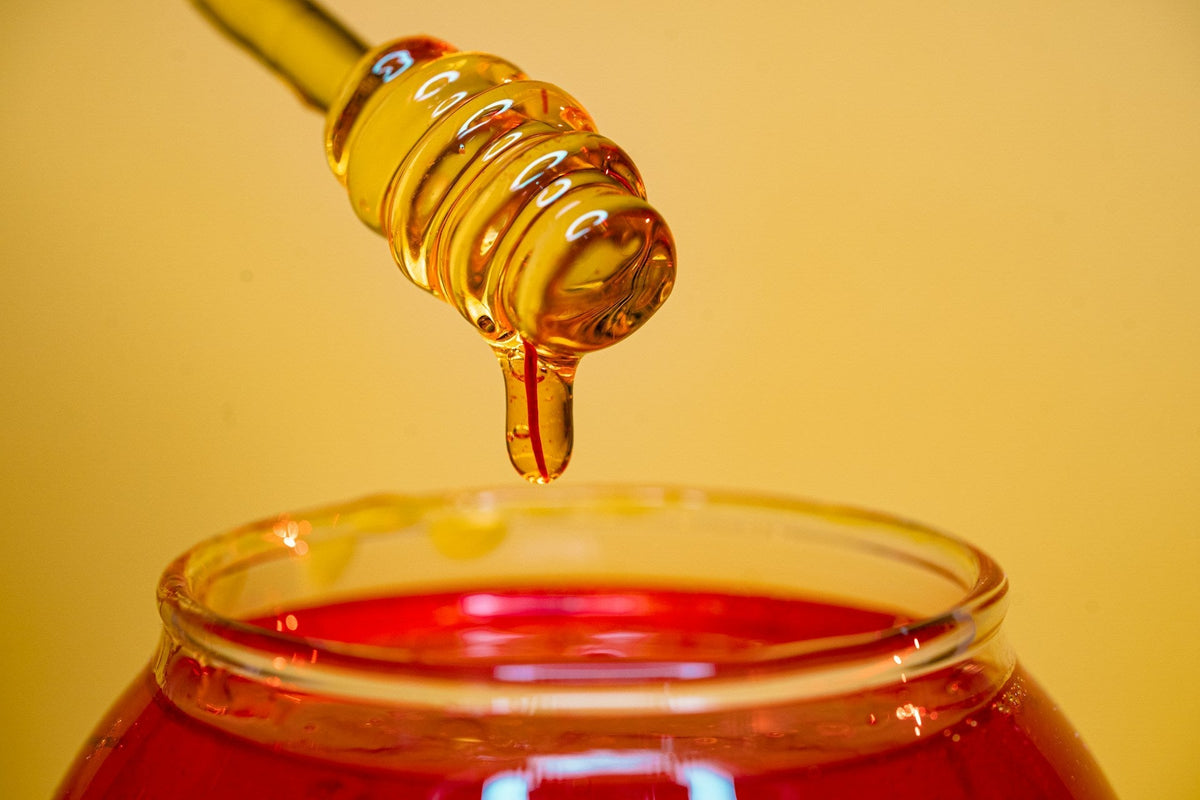
Honey Storage · Crystallization · Shelf Life · Food Waste
Pure honey is one of the most shelf-stable foods in the kitchen. When it is stored tightly covered and protected from excess moisture, it can remain usable for a very long time.
That does not mean honey never changes. It can crystallize, darken, lose aroma, absorb moisture, or develop different flavors as it ages. And if enough water or contamination enters the jar, honey can ferment or spoil.
The most common misunderstanding is crystallization: honey that turns cloudy, grainy, or solid has not automatically gone bad. Crystallization is a normal physical change in the sugars and can usually be reversed with gentle warming.

Does Honey Expire?
Properly stored pure honey can remain usable for years and does not have a simple hard expiration date.
- Best storage: tightly closed at normal room temperature in a dry cupboard.
- Refrigeration: generally unnecessary and promotes crystallization.
- Crystallized honey: normally still usable; crystallization is not spoilage.
- Quality: flavor, aroma, color, and texture can change over time.
- Moisture matters: diluted or contaminated honey can ferment or support microbial growth.
- Spoilage signs: foaming, alcoholic or fermented odor, mold, leaking contamination, or other abnormal changes.
Simple rule: crystals are normal; fermentation and contamination are not.
1. Honey Storage Chart
| Honey Condition | What It Means | What to Do |
|---|---|---|
| Liquid, normal aroma | Normal honey | Keep tightly sealed at room temperature |
| Cloudy or grainy | Crystallization beginning | Still usable; warm gently if liquid honey is preferred |
| Mostly solid crystals | Advanced crystallization | Still normally usable if there are no spoilage signs |
| Darker color over time | Natural quality change or heat exposure | Evaluate aroma, flavor, and storage history |
| Foaming or bubbling without agitation | Possible fermentation | Discard |
| Alcoholic or fermented smell | Possible yeast activity | Discard |
| Visible mold | Contamination / spoilage | Discard |
| Water entered the jar | Higher spoilage risk | Do not assume normal honey shelf life still applies |
2. Does Honey Go Bad?
Pure honey stored correctly is extremely resistant to ordinary microbial spoilage, but honey can still become unusable under the wrong conditions.
Honey's stability comes partly from its very low available water and high concentration of sugars. Most microorganisms cannot grow well in undiluted honey.
Penn State Extension describes properly stored honey as essentially capable of keeping indefinitely, provided it remains tightly covered and dry.
That is different from saying every open jar of honey can never spoil.
When Can Honey Go Bad?
The biggest storage problem is added moisture.
If water, steam, a wet spoon, food crumbs, fruit juice, or other contamination enters the container, the honey can become diluted. That changes the environment and can make the growth of yeasts or molds more possible.
Honey can also lose desirable quality through:
- excess heat;
- long exposure to light;
- odor absorption;
- poorly sealed containers;
- repeated contamination from utensils;
- long-term flavor and color changes.
Shelf-Stable Does Not Mean Indestructible
Pure honey has unusual natural stability, but the storage conditions that create that stability matter. Keep the jar dry, clean, tightly covered, and away from excessive heat.
3. How Long Does Honey Last?
Commercial honey can have an indefinite practical shelf life when it remains uncontaminated and properly stored.
Utah State University Extension notes that commercial honey resists microbial growth and can have an indefinite shelf life, while an approximate two-year best-quality reference may still appear on packaged sugar products.
That two-year figure should not be read as a sudden safety cutoff.
How Long Is Honey Good For?
Think about honey in two separate timelines:
| Question | Practical Answer |
|---|---|
| How long can pure honey remain usable? | Potentially for years when tightly sealed, dry, and uncontaminated |
| How long does honey keep peak quality? | Flavor, aroma, color, and texture gradually change; packaged honey may carry a quality date |
| Does crystallization end shelf life? | No |
| Does a best-by date automatically mean spoilage? | No; storage history and actual condition still matter |
| Can contaminated or diluted honey spoil sooner? | Yes |
This quality-versus-safety distinction is part of the broader Food Storage & Waste Reduction Guide.
4. Does Honey Need to Be Refrigerated?
No. Pure honey generally does not need refrigeration.
A tightly closed jar stored in a dry cupboard at normal room temperature is usually the better household storage method.
Penn State Extension specifically advises against refrigerating honey because cooler temperatures encourage crystallization.
Why Refrigeration Is Usually Unnecessary
Unlike milk, meat, or cooked leftovers, honey does not depend on refrigeration for ordinary shelf stability when it remains pure and undiluted.
Refrigeration can instead:
- accelerate crystallization;
- make honey much harder to pour;
- make scooping and measuring more difficult;
- provide little practical storage benefit for normal pure honey.
Where Should Honey Be Stored?
Use a pantry or cupboard that is:
- dry;
- away from direct sunlight;
- away from the stove or oven;
- away from steam;
- free of strong odors;
- at a reasonably stable room temperature.
Better than the refrigerator: a clean, dry cupboard with the lid tightly closed.
5. Does Crystallized Honey Mean It Is Bad?
No. Crystallization is a normal physical process and does not by itself mean that honey has spoiled.
Honey contains several sugars, especially glucose and fructose, dissolved in a relatively small amount of water.
Over time, some glucose can come out of solution and form crystals. As crystallization progresses, honey can change from clear and fluid to cloudy, grainy, creamy, or almost solid.
Why Does Honey Crystallize?
The rate depends on several factors:
- glucose-to-fructose ratio;
- temperature;
- moisture level;
- pollen and other natural particles;
- processing and filtration;
- the floral source of the honey.
Penn State's beekeeping guidance notes that approximately 57°F / 14°C is especially favorable for granulation, which helps explain why cool storage can accelerate crystallization.
Why Does One Jar Crystallize Faster Than Another?
Honey is not one chemically identical product. Floral source changes its glucose, fructose, moisture, color, aroma, and crystallization behavior.
Some honeys crystallize quickly. Others remain liquid for much longer.
That difference is not evidence that the liquid jar is “real” and the crystallized jar is “fake.”
Crystallization Is Not a Purity Test
Real honey can crystallize at very different rates. Texture alone cannot prove whether honey is authentic or adulterated.
6. How to Make Crystallized Honey Liquid Again
If you prefer liquid honey, crystallized honey can usually be gently warmed.
Warm-Water Method
- Place the honey container in a larger bowl or pan.
- Add hot but not violently boiling water around the container.
- Let the honey warm gradually.
- Stir when practical.
- Repeat with fresh warm water if necessary until the crystals dissolve.
Penn State Extension recommends warming the open jar in hot water until the crystals disappear.
Avoid Excessive Heat
High heat can darken honey and alter aroma and flavor.
The goal is not to cook the honey. It is simply to give the sugar crystals enough gentle warmth to dissolve back into solution.
Will It Crystallize Again?
Possibly.
Re-liquefying honey changes its current texture but does not permanently change the natural sugar balance that caused crystallization in the first place.
7. Can Honey Spoil?
Yes, especially when its moisture content is increased, or the container becomes contaminated.
This is the important distinction between normal aging and actual spoilage.
Fermented Honey
Penn State Extension notes that when moisture enters honey and dilutes it sufficiently, conditions can become favorable for yeast and mold growth.
Warning signs include:
- unexpected foam;
- persistent bubbles;
- alcoholic smell;
- fermented or sour aroma;
- pressure or unusual gas formation;
- obvious mold.
Honey that is foaming and smells alcoholic should be discarded.
Crystals vs Fermentation
| Crystallization | Fermentation / Spoilage |
|---|---|
| Grainy or solid texture | Foaming or gas activity |
| Normal honey aroma | Alcoholic, fermented, sour, or abnormal smell |
| No mold | May show mold or contamination |
| Usually reversible with gentle warming | Should be discarded |
| Normal physical sugar change | Microbial spoilage or contamination problem |

8. Does Raw Honey Go Bad?
Raw honey is also highly shelf-stable when it is kept clean, dry, and tightly sealed.
However, raw or less-filtered honey may contain more pollen, wax particles, and other natural material that can provide sites where sugar crystals begin forming.
That means raw honey may crystallize more readily than highly filtered commercial honey.
Crystallized Raw Honey Is Usually Normal
A jar of raw honey becoming opaque, grainy, or firm does not mean it has spoiled.
Look instead for actual spoilage indicators such as:
- fermented odor;
- unusual foaming;
- visible mold;
- water contamination;
- foreign material introduced after opening.
Store Raw Honey the Same Basic Way
Keep it tightly closed in a dry place at room temperature and protect it from excessive heat, moisture, and direct sunlight.
9. Best Way to Store Honey
The best storage routine is simple.
- Keep the lid tight.
- Store at normal room temperature.
- Choose a dry cupboard.
- Keep honey away from steam and water.
- Use clean, dry utensils.
- Avoid direct sunlight and excess heat.
- Do not refrigerate simply to extend shelf life.
Use a Dry Spoon
Putting a wet spoon back into honey introduces exactly what honey naturally has very little of: extra water.
This matters especially when honey is repeatedly used for tea, breakfast, cooking, or baking.
Keep the Container Closed
Honey can absorb moisture and odors from the environment. A tight lid protects both shelf stability and flavor.
Glass or Food-Grade Containers
Glass jars and suitable food-grade containers work well. Utah State University notes that honey is mildly acidic and should not be stored in unsuitable reactive metal containers.
Do Not Store Honey Beside Heat
Cabinets directly above ovens, dishwashers, or other warm appliances can experience repeated temperature swings.
A stable, room-temperature cupboard is preferable.
For the wider pantry and food-storage system, use the Food Storage & Waste Reduction Hub.
10. Honey and Infants: One Important Safety Rule
Do Not Give Honey to Children Under 12 Months
Honey can contain spores of bacteria that cause infant botulism.
CDC guidance says honey should not be given to a child younger than 1 year, including honey added to food, water, formula, or a pacifier.
This rule is unrelated to whether the honey looks fresh, is raw or processed, is crystallized, or is within a best-by date.
11. What to Do With Honey You Cannot Use
Because honey stores so well, actual honey waste is often preventable.
The better order is:
- Check whether it has merely crystallized.
- Re-liquefy crystallized honey if needed.
- Use older honey in cooking, baking, sauces, or drinks when still suitable.
- Do not eat honey showing fermentation, mold, or other clear spoilage. If it has become unavoidable food waste, normal household amounts can be processed in GEME together with other suitable solid food scraps.
- Compost only suitable unavoidable residues through the right system.
This follows the same household hierarchy used in How to Reduce Food Waste at Home: store and use edible food first, compost suitable unavoidable waste last.
Can Honey Be Composted?
Honey is biodegradable, but its high sugar concentration makes it a very dense food input.
In an open backyard pile, pouring a jar of honey over the surface is a poor composting strategy because it can create sticky concentrated zones and attract insects or other animals.
If only a small amount remains, disperse it through a larger, balanced compost mass rather than creating a concentrated layer.
For system-specific material guidance, see What Can You Compost at Home?.
Honey Residue in GEME Terra 2 or GEME Pro
Spoiled honey can go into GEME in normal household amounts. Fermented or no-longer-edible honey is still biodegradable food waste. However, because honey is highly concentrated in sugar and can behave like a thick liquid, avoid pouring a large jar into the chamber at once. Add smaller amounts together with a varied mix of solid food scraps so the chamber’s moisture, aeration, and microbial balance remain stable.
- Use edible honey first.
- Do not pour a large quantity into the chamber all at once.
- Keep concentrated sweet liquids from dominating a single load.
- Add suitable residues together with varied solid food scraps.
- Follow normal loading limits and current chamber condition.
The broader managed-input decision framework is available in What Can You Put in an Electric Composter? Meat, Dairy & Bones.
Crystallized Honey Is Food, Not Waste
Do not compost honey simply because it has turned solid. Crystallization is normally reversible and does not mean the honey has expired.
Store Honey First. Compost Only What Truly Becomes Waste.
Crystals are usually a texture change, not a reason to throw honey away. Keep honey dry, sealed, and at room temperature, restore crystallized honey gently when needed, and reserve composting for genuinely unavoidable organic waste.
12. Frequently Asked Questions
Does honey expire?
Pure honey stored tightly sealed and protected from moisture can remain usable for a very long time. Packaged honey may carry a best-quality date, but that does not mean every jar suddenly becomes spoiled on that date.
Does honey go bad?
Pure honey is highly resistant to ordinary microbial spoilage, but honey can go bad when it becomes sufficiently diluted, contaminated, or fermented. Foaming, alcoholic odor, mold, or other abnormal changes are reasons to discard it.
Can honey go bad?
Yes, particularly if water or contamination enters the jar. Properly stored undiluted honey is extremely shelf-stable.
Can honey expire?
Honey can lose quality over time, but pure honey does not have a simple universal expiration point. Storage condition and contamination matter more than a calendar date alone.
Does honey spoil?
It can. Added moisture can dilute honey enough to allow fermentation or microbial spoilage. Honey that is foaming, smells alcoholic or fermented, or shows mold should be discarded.
Can honey spoil?
Yes. Pure honey resists spoilage well, but dilution, wet utensils, contamination, poor sealing, or unsuitable storage can change that.
Does honey ever go bad?
Properly stored pure honey may remain usable for years, but it is not immune to contamination, fermentation, moisture exposure, or quality deterioration.
How long does honey last?
Commercial honey can have an indefinite practical shelf life when properly stored. A best-quality date may still be used because color, flavor, aroma, and texture can change over time.
How long can honey last?
Pure honey can last for many years when tightly covered, dry, and uncontaminated. Crystallization during that period does not by itself mean the honey has spoiled.
How long is honey good for?
Honey does not have the short refrigerator-style shelf life of perishable foods. Utah State University Extension describes commercial honey as having an indefinite shelf life, with quality changes becoming the main long-term concern.
How long will honey last?
Proper storage can keep honey usable for years. Seal the jar tightly, keep it dry, and store it at a stable room temperature away from excessive heat and sunlight.
Does honey need to be refrigerated?
No. Pure honey is normally best stored tightly closed at room temperature. Refrigeration is generally unnecessary and promotes crystallization.
Does raw honey go bad?
Raw honey is highly shelf-stable when clean, dry, and properly sealed. It may crystallize faster because natural particles can encourage crystal formation, but crystallization is not spoilage.
Is crystallized honey bad?
No. Crystallization is a normal physical change in honey sugars. If the honey otherwise smells normal and shows no signs of contamination or fermentation, it can usually be used normally.
How do you fix crystallized honey?
Place the honey container in hot but not boiling water and allow it to warm gradually until the crystals dissolve. Avoid excessive heat because it can change the honey's flavor and color.
Why did my honey turn solid?
Glucose in honey can naturally form crystals over time. Floral source, glucose-to-fructose ratio, temperature, moisture, filtration, and natural particles all influence how quickly this happens.
Can babies eat honey?
No honey should be given to children younger than 12 months because honey can contain spores associated with infant botulism.


Commenta
Nota che i commenti devono essere approvati prima di essere pubblicati.
Questo sito è protetto da hCaptcha e applica le Norme sulla privacy e i Termini di servizio di hCaptcha.