

Cookies · Biscuits · Food Storage · Baked Goods · Composting Basics
Most ordinary baked cookies last about 2–3 weeks at room temperature, according to a general USDA storage guide, when stored properly. Homemade and bakery cookies can also be refrigerated for about two months or frozen for 8–12 months for longer-term quality.
And yes, stale or unwanted cookies can often be composted in small amounts. But cookies are not the same as fruit peels: they may contain flour, sugar, butter, oil, chocolate, nuts, dairy or frosting, so the best composting method depends on the recipe and quantity.
By Matthew Moore · Last reviewed August 24, 2026

Photo: Prchi Palwe / Unsplash
Quick Answer: How Long Do Cookies Last?
USDA's general guide for bakery or homemade cookies is 2–3 weeks at room temperature, about 2 months refrigerated and 8–12 months frozen.
These are broad storage guidelines, not guarantees for every recipe. Cookies with cream cheese frosting, custard, fresh dairy or other perishable fillings may need refrigeration and much shorter handling windows. Always follow the recipe or package instructions when they require cold storage.
| Cookie / Biscuit | General Storage Guide | Best Practice |
|---|---|---|
| Ordinary baked cookies | About 2–3 weeks at room temperature | Cool completely, then store airtight. |
| Homemade cookies | USDA general guide: about 2–3 weeks at room temperature | Recipe moisture and fillings can shorten shelf life. |
| Refrigerated cookies | About 2 months | Seal well to prevent drying and odor absorption. |
| Frozen baked cookies | 8–12 months for quality | Use freezer-safe airtight packaging. |
| Cream-filled / refrigerated cookies | Recipe-specific | Follow refrigeration and package instructions. |
| Packaged shelf-stable cookies | Follow package date and storage instructions | Best-by dates often describe expected quality rather than an instant safety cutoff. |
For the wider storage hierarchy, pantry, refrigerator, freezer, date labels and waste prevention, see the Food Storage & Waste Reduction Guide.
Table of Contents
- Can Cookies Expire?
- How Long Do Cookies Last?
- How Long Do Homemade Cookies Last?
- How Long Are Baked Cookies Good For?
- How Long Do Packaged Cookies or Biscuits Last?
- How to Store Cookies Properly
- Can You Freeze Cookies?
- How Do You Know Cookies Have Gone Bad?
- Can You Compost Cookies?
- Can Cookies Go in Backyard Compost?
- Can Cookies Go in GEME Terra 2?
- Which Cookies Need More Composting Care?
- Store First, Compost Later
- What Happens After Cookie Scraps Are Composted?
- Frequently Asked Questions
- Sources
1. Can Cookies Expire?
Yes. Cookies can expire, become stale or otherwise lose quality.
But “expired” does not always mean that a dry packaged cookie suddenly becomes unsafe at midnight on the date printed on the box.
Many ordinary cookies are relatively low-moisture shelf-stable foods.
Over time, several things can happen:
- the cookie absorbs humidity and becomes soft;
- a soft cookie loses moisture and becomes hard;
- butter, nuts or added oils become rancid;
- flavor compounds fade;
- chocolate develops quality changes;
- poor packaging allows insects or moisture inside;
- mold develops after moisture exposure.
FDA guidance explains that many package dates are intended to communicate expected quality rather than a universal food-safety deadline.
That makes cookies similar to other dry snacks. The Can Popcorn Expire? guide explains the same distinction between shelf life, quality decline, rancidity and genuine spoilage.
Do not use the date label to override obvious spoilage. Mold, a rancid smell, insects, dampness, damaged packaging or a distinctly abnormal appearance are reasons not to eat the cookies.
2. How Long Do Cookies Last?
USDA's current cookie-storage guidance is unusually straightforward:
These numbers answer the broad query “how long can cookie last?”, but they should not be interpreted as identical performance for every recipe.
Cookie shelf life changes with:
- water activity and moisture;
- fat content;
- nuts and seeds;
- fresh fruit;
- dairy-based fillings;
- frosting;
- packaging quality;
- temperature;
- humidity;
- how often the container is opened.
A dry ginger biscuit and a soft homemade cookie filled with cream cheese do not have the same storage needs simply because both can be called cookies.

3. How Long Do Homemade Cookies Last?
For a general answer to “how long are homemade cookies good for?”, USDA gives the same broad room-temperature window:
About 2–3 weeks at room temperature for bakery or homemade cookies.
However, homemade cookies often have fewer preservatives than mass-produced packaged cookies.
Their eating quality may therefore decline sooner even when they remain within a general storage window.
Dry or Crisp Homemade Cookies
Shortbread, ginger biscuits, sugar cookies and other relatively dry styles usually maintain texture best when completely cooled and sealed away from humidity.
Soft or Chewy Cookies
Soft chocolate-chip, oatmeal or molasses cookies can lose their preferred texture as moisture migrates in or out of the cookie.
Filled or Frosted Cookies
If a recipe contains a filling or topping that normally requires refrigeration, such as some cream cheese, custard or fresh dairy fillings, follow that recipe's cold-storage instructions rather than the general shelf-stable cookie guidance.
Best rule: recipe-specific refrigeration instructions override a general “cookies last 2–3 weeks” guideline.
4. How Long Are Baked Cookies Good For?
For ordinary shelf-stable baked cookies, the USDA 2–3 week room-temperature guide is a useful starting point.
But cooling before storage is important.
Putting warm cookies into a sealed container traps steam.
That can:
- soften crisp cookies;
- create condensation;
- increase surface moisture;
- encourage premature quality decline.
Let cookies cool completely before packing them.
Then move them into an airtight container as soon as practical rather than leaving them uncovered for days.
5. How Long Do Packaged Cookies or Biscuits Last?
Commercial cookies and British biscuits can last significantly longer than freshly baked cookies because manufacturers can control:
- moisture;
- packaging atmosphere;
- fat formulation;
- preservatives;
- oxygen exposure;
- barrier packaging.
That is why the most responsible answer for an unopened commercial packet is:
Follow the manufacturer's date and storage instructions for that specific product.
A best-before or best-if-used-by date often relates primarily to expected quality.
After opening, exposure to air and humidity becomes much more important.
Fold or reseal the original liner tightly, or transfer the biscuits to an airtight container.
The general principles are part of GEME's Food Storage & Waste Reduction Hub.
6. How to Store Cookies Properly
The best way to store ordinary shelf-stable cookies is:
Cool completely → seal airtight → store cool and dry → freeze surplus early.
1. Let Cookies Cool Completely
Do not seal warm cookies while they are releasing steam.
2. Use an Airtight Container
A good seal slows moisture exchange and protects cookies from pantry humidity and odors.
3. Keep Crisp and Soft Cookies Separate
Moisture moves between foods.
If crisp biscuits and soft cookies share one container, the crisp ones may soften while the soft ones dry out.
4. Keep Cookies Away From Heat and Steam
Do not store them:
- beside a stove;
- above a dishwasher;
- beside a kettle;
- in direct sunlight;
- in a humid cabinet.
5. Freeze What You Will Not Finish
Freezing is usually a better long-term strategy than leaving a large batch on the counter until quality declines.
For broader dry-food and pantry management, use the Food Storage Guide.

7. Can You Freeze Cookies?
Yes.
USDA states that baked cookies retain their quality in the freezer for about:
8–12 months.
That is a quality window rather than a promise that every cookie will taste identical after one year.
For best results:
- cool cookies fully;
- freeze in realistic serving-size portions;
- use airtight freezer-safe packaging;
- remove excess air where practical;
- label the freezing date;
- thaw only the amount you intend to eat.
Cookies with delicate frostings or fillings may freeze differently, so follow recipe-specific guidance.
8. How Do You Know Cookies Have Gone Bad?
A stale cookie is not automatically the same thing as a spoiled cookie.
Rancid Butter, Oil or Nuts
Cookies containing butter, peanut butter, nuts, seeds or other fats can develop rancid flavors and odors over time.
Rancid fat may smell:
- paint-like;
- stale;
- soapy;
- waxy;
- bitter;
- otherwise clearly abnormal.
Mold
Visible mold means the cookies should be discarded from the food supply.
FDA advises consumers to throw out moldy food rather than assuming normal appearance elsewhere in the item proves safety.
Moisture or Insect Damage
Pantry food that has become wet or infested should not be eaten.
Do not taste-test obviously moldy, rancid or contaminated cookies to decide whether they are safe.
9. Can You Compost Cookies?
Yes, cookies and British sweet biscuits are biodegradable food materials and can be composted in appropriate amounts.
Typical cookie ingredients include:
- flour;
- sugar;
- butter or oil;
- eggs;
- oats;
- chocolate;
- nuts;
- spices.
Microorganisms can break down these food materials.
The important question is not:
“Is a cookie organic?”
It is:
“Which composting system can handle this sugary, baked, sometimes fatty food without creating pests, odor or an overloaded wet/oily zone?”
The broader What Can You Compost at Home? guide already treats bread and grain-based foods as compostable but more pest-sensitive than simple vegetable peels.
10. Can Cookies Go in Backyard Compost?
Yes, but small amounts are better.
Cookies combine refined flour, sugar and often fat.
That makes them attractive to:
- rodents;
- raccoons and other wildlife;
- ants;
- flies;
- other scavengers.
They can also form sticky or greasy clumps when wet.
How to Compost Cookies Outdoors
- Break large cookies into smaller pieces.
- Add only modest amounts.
- Bury them deeply inside the active pile.
- Cover with dry brown material.
- Mix rather than leaving a concentrated cookie layer.
- Keep the pile aerated.
- Do not add plastic wrappers or packaging.
Do not dump an entire forgotten tin of rich cookies on top of an open compost pile. The material may be biodegradable, but the pest problem begins before microbes finish the job.
For the full backyard system, read the Complete Home Composting Guide.
If you are choosing between outdoor and indoor methods, see Compost Pile vs Electric Composter.
11. Can Cookies Go in GEME Terra 2?
Ordinary cookie or biscuit scraps can be suitable as part of a varied household food-waste stream in GEME Terra 2.
For a plain cookie:
- break very large or hard cookies into smaller pieces;
- add them with normal mixed food scraps;
- avoid a concentrated cookie-only load.
Terra 2 operates through continuous aerobic microbial decomposition rather than simply drying the cookie.
Learn more in How GEME Continuous Microbial Composting Works.
What About Chocolate Chip Cookies?
Normal amounts of chocolate chips inside an ordinary baked cookie do not turn the food into a non-compostable object.
Treat the complete cookie as a baked food scrap and keep quantities reasonable.
What About Butter Cookies or Shortbread?
They contain more fat than very lean biscuits.
A few scraps are different from adding a large batch of butter-heavy waste at once.
What About Frosted Cookies?
A light coating of frosting on one cookie is part of normal mixed food waste.
A large quantity of frosting, melted buttercream or cream filling is a much more concentrated sugar-and-fat input.
For the wider boundary, use Electric Composter Salt & Oil Boundaries.
For complex leftovers containing dairy or other richer ingredients, also review What Can You Put in an Electric Composter?.
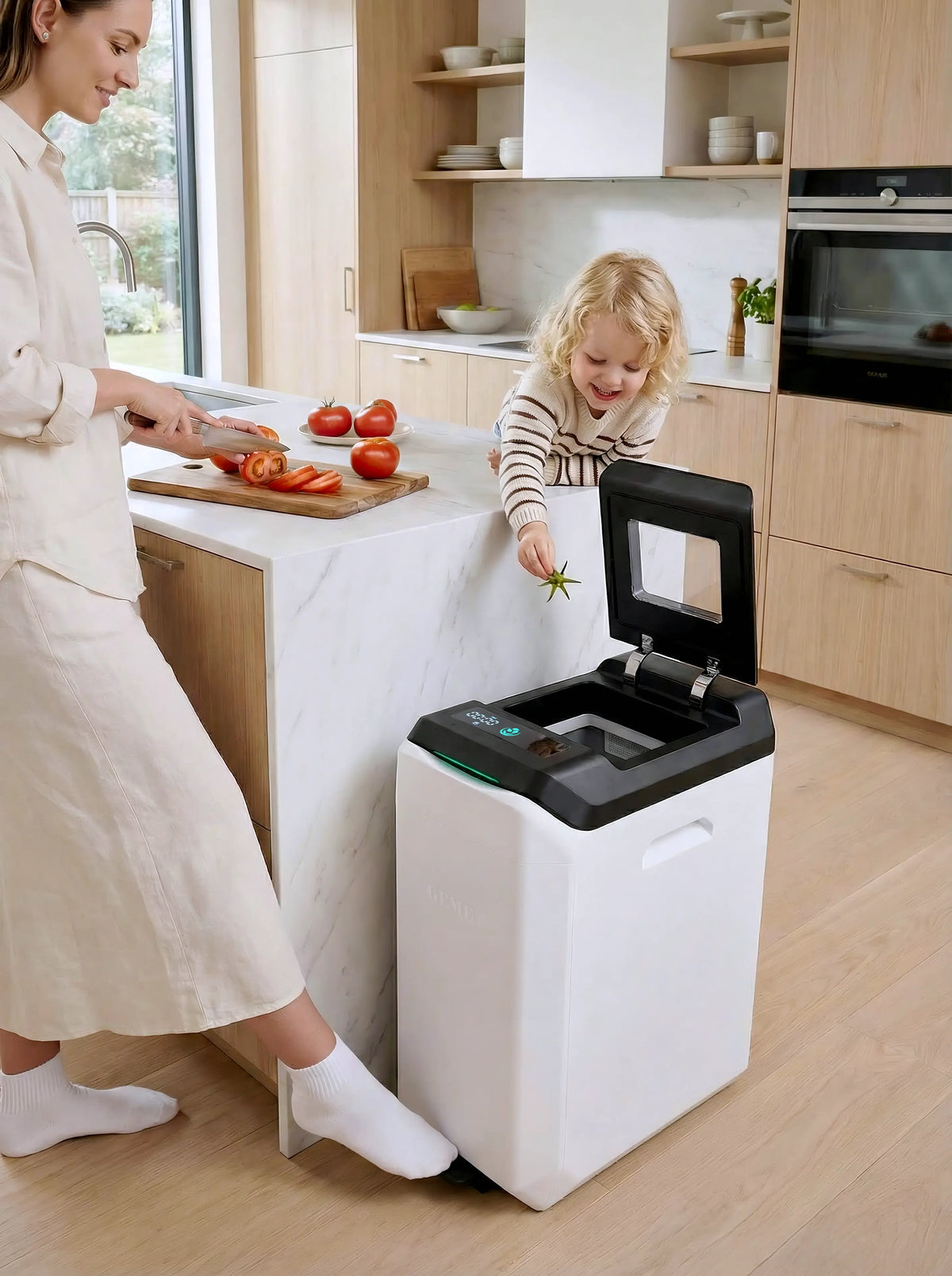
Store Better First. Compost What Remains.
Cookies Are Food Before They Become Food Waste
Keep baked cookies airtight, freeze surplus early, and avoid throwing away edible batches simply because they have lost a little crispness.
When cookies genuinely become unavoidable food scraps, Terra 2 supports microbial processing of suitable mixed kitchen waste within normal input boundaries.
Explore GEME Terra 2 →12. Which Cookies Need More Composting Care?
| Cookie / Biscuit Type | Compost? | Main Consideration |
|---|---|---|
| Plain sugar cookie | Yes | Break up and add in moderation. |
| Shortbread / butter biscuit | Yes, cautiously | Higher fat; do not add large concentrated amounts. |
| Chocolate chip cookie | Yes | Normal household scraps are manageable. |
| Oatmeal cookie | Yes | Treat as grain-based baked food. |
| Frosted cookie | Yes, in moderation | Higher sugar/fat; pace large amounts. |
| Cream-filled sandwich biscuit | System-dependent | Dairy/fat content and pest attraction matter. |
| Cookie with plastic wrapper | Food only | Remove wrapper, foil, tray and non-food packaging. |
13. Store Cookies First, Compost Them Later
A stale cookie is not always a wasted cookie.
Before composting:
- use cookies while they are still fresh;
- freeze surplus early;
- crumble dry cookies into appropriate desserts;
- use safe stale biscuits as a crust or topping;
- share surplus while quality is still good.
Composting belongs later in the food hierarchy.
Bake or buy
↓
Store airtight
↓
Eat / share / repurpose
↓
Freeze surplus
↓
Compost suitable unavoidable scraps
This is the same prevention-first system used throughout the GEME Food Storage & Waste Reduction Hub.
For the broader kitchen routine, see the Zero-Waste Kitchen Guide.
14. What Happens After Cookie Scraps Are Composted?
Composted cookies do not become “cookie fertilizer.”
They become one small component of a mixed organic feedstock.
Flour contributes plant-derived carbohydrates, while eggs, butter, nuts and other ingredients contribute different organic materials and nutrients.
The final compost profile depends on everything else in the composting stream.
For Terra 2, the resulting material should be treated as a Compost Base for soil blending.
Do not plant directly into concentrated fresh output.
Use the Advanced GEME Compost Application Guide for the Terra 2-specific screening and soil-blending workflow.
For broader gardens, pots, raised beds and lawns, see How to Use Compost Correctly.
And if you want to understand why household compost cannot be reduced to one guaranteed fertilizer number, read the NPK Test of Home Compost Output (N=50).
15. The Simplest Cookie Storage and Composting Rule
Store the cookie. Freeze the surplus. Compost what genuinely becomes waste.
Food Waste Prevention Comes First
Don't Compost a Good Cookie Too Early
Keep cookies and biscuits sealed, freeze what you cannot finish and use composting only for suitable unavoidable scraps. GEME Terra 2 supports continuous microbial processing of everyday mixed kitchen waste within clear food-input boundaries.
16. Frequently Asked Questions About Cookies, Biscuits & Composting
Can cookies expire?
Yes. Cookies can become stale, rancid, moldy or otherwise lose quality. For packaged shelf-stable cookies, a best-by date often relates primarily to expected quality rather than an instant food-safety cutoff.
How long can a cookie last?
USDA gives bakery or homemade cookies a general room-temperature storage time of about two to three weeks. Actual shelf life depends on recipe, moisture, fillings, packaging and storage conditions.
How long do cookies last?
As a general USDA guide, bakery or homemade cookies can be stored for about two to three weeks at room temperature, about two months in the refrigerator and eight to twelve months in the freezer for quality.
How long are cookies good for?
Ordinary baked cookies are generally covered by the USDA two-to-three-week room-temperature guideline. Cookies that contain perishable fillings or frostings may require refrigeration and shorter storage.
How long are homemade cookies good for?
USDA's broad guidance is about two to three weeks at room temperature for homemade cookies. Homemade recipes, moisture and ingredients can cause quality to decline sooner.
How long do homemade cookies last?
A useful general guide is two to three weeks at room temperature when properly stored in an airtight container. Refrigerated cookies may keep for around two months, and frozen cookies for eight to twelve months, for quality.
How long are baked cookies good for?
Ordinary baked cookies can generally be stored for about two to three weeks at room temperature under USDA guidance. Cool them completely before placing them in an airtight container.
How should cookies be stored?
Cool cookies completely and store ordinary shelf-stable cookies in a clean, airtight container in a cool, dry place. Keep crisp and soft cookies separate and freeze surplus for longer storage.
Do cookies need to be refrigerated?
Most ordinary dry baked cookies do not need refrigeration for short-term storage. Cookies with perishable cream, custard, dairy or recipe-specific fillings may require refrigeration.
Can you freeze cookies?
Yes. USDA states that cookies can retain quality for approximately eight to twelve months in the freezer when stored properly.
How long do biscuits last?
For British sweet biscuits comparable to ordinary cookies, the same general storage principles apply. Commercial packets should follow manufacturer guidance, while homemade or bakery cookies have a USDA general room-temperature guide of about two to three weeks.
Are cookies and biscuits the same thing?
In British English, biscuit commonly refers to the small, flat, usually sweet food called a cookie in American English. In American English, biscuit can also mean a soft quick bread, so the terms are not interchangeable in every context.
Can you compost cookies?
Yes. Plain stale cookies and similar sweet biscuits can generally be composted in modest amounts. Break them up, remove all packaging and use an appropriate composting system.
Can you compost biscuits?
Yes, when biscuit means the British sweet baked food. Plain biscuit scraps are biodegradable, but sugary, buttery or cream-filled biscuits should be composted in moderation.
Can moldy cookies be composted?
Moldy cookies should not be eaten. They may be suitable for an appropriate composting system, but keep packaging out and avoid large sugary or fatty loads in an open backyard pile.
Can chocolate chip cookies be composted?
Yes, ordinary chocolate chip cookie scraps can be composted as food waste in reasonable quantities. Outdoor piles should bury them well because baked sugary foods can attract pests.
Can frosted cookies be composted?
Small amounts can be compatible with managed composting, but frosting adds concentrated sugar and often fat or dairy. Avoid adding large quantities of frosting as one load.
Can GEME Terra 2 compost cookies?
Ordinary cookie and biscuit scraps can be processed as part of a varied household food-waste stream. Avoid concentrated large loads of rich frosting, free oil or very wet cream fillings and follow current food-input guidance.
17. Authoritative Sources & Further Reading
- USDA FSIS — How Should Cookies Be Stored?
- U.S. FDA — Are You Storing Food Safely?
- U.S. FDA — How to Cut Food Waste and Maintain Food Safety
- Cambridge Dictionary — Biscuit
- Cambridge Dictionary — Cookie
- GEME — Food Storage & Waste Reduction Guide
- GEME — Can Popcorn Expire?
- GEME — What Can You Compost at Home?
- GEME — Complete Home Composting Guide
- GEME — Electric Composter Salt & Oil Boundaries
- GEME — Electric Composter Input Guide
- GEME — Advanced Compost Application Guide
Sources reviewed August 24, 2026. USDA cookie-storage times are general guidance for bakery or homemade cookies and should not override recipe-specific refrigeration instructions for perishable fillings, frostings or specialty baked goods. Commercial packaged cookies and biscuits should be stored according to their current manufacturer instructions.


Commenta
Nota che i commenti devono essere approvati prima di essere pubblicati.
Questo sito è protetto da hCaptcha e applica le Norme sulla privacy e i Termini di servizio di hCaptcha.