
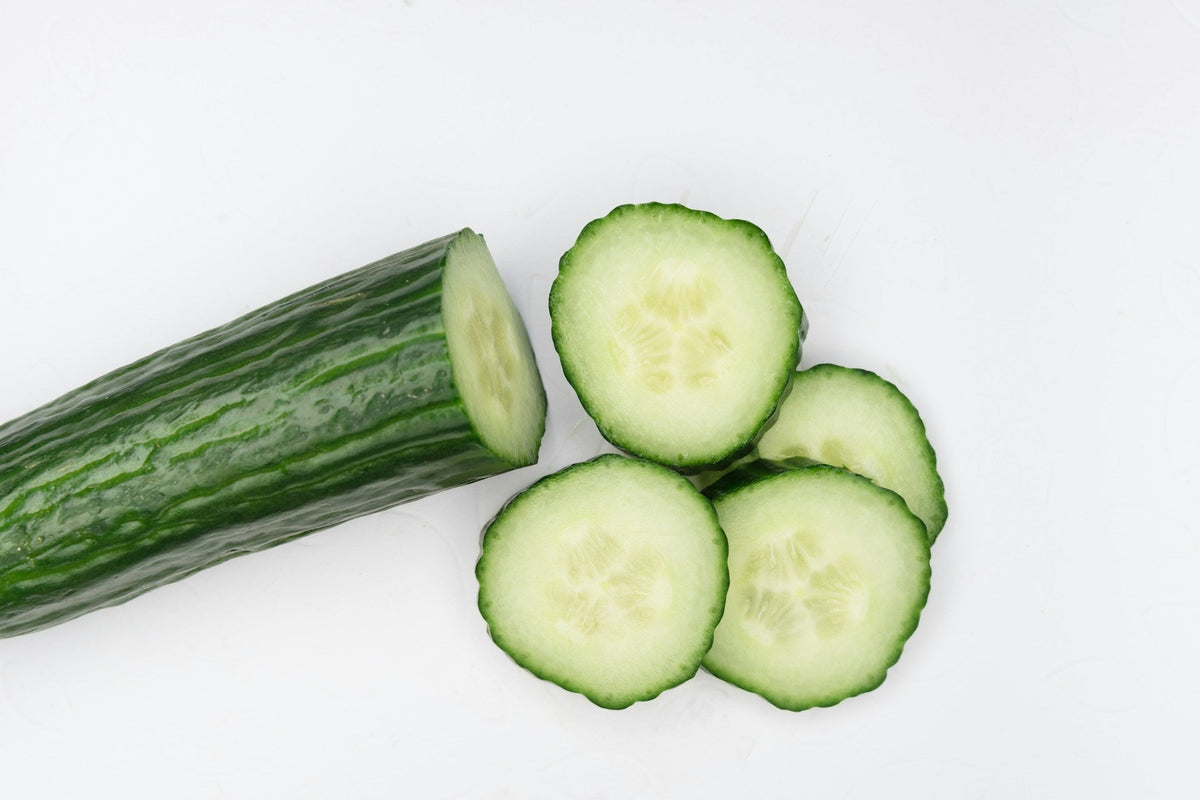
Cucumber Storage · Refrigerator · Freezing · Food Waste
The best way to store cucumbers is to keep them cool, humid, protected from moisture loss, and away from ethylene-producing produce. The complication is that cucumbers prefer warmer storage than a typical household refrigerator.
Commercially, cucumbers perform best around 50–55°F / 10–12.5°C at high relative humidity. Most homes do not have a storage zone that stays at that temperature, so the refrigerator becomes the practical short-term option for many households.
For normal home use, plan around roughly one week of refrigerated storage. Keep cucumbers away from apples, bananas, melons, and tomatoes, avoid the coldest refrigerator zones, and use softening cucumbers before they become food waste.

How to Store Cucumbers
For most households, refrigerate cucumbers for short-term storage, but protect them from excessive cold and dehydration.
- Choose firm cucumbers without soft, sunken, slimy, or yellowing areas.
- Keep them dry before storage. Wash shortly before use rather than trapping extra surface moisture in storage.
- Use a perforated or loosely closed produce bag to reduce moisture loss while allowing some airflow.
- Avoid the coldest refrigerator zones because cucumbers are chilling-sensitive.
- Keep cucumbers away from ethylene-producing fruit such as apples, bananas, melons, and tomatoes.
- Plan to use refrigerated cucumbers within about a week.
Simple rule: keep cucumbers cool but not freezing cold, protect them from dehydration, separate them from ethylene-producing produce, and use them before they become soft or watery.
1. Do Cucumbers Need to Be Refrigerated?
For most households, refrigeration is the practical answer, but cucumbers are unusual because an ordinary refrigerator is colder than their ideal storage temperature.
UC Davis identifies approximately 50–55°F / 10–12.5°C and about 95% relative humidity as optimal postharvest conditions for cucumbers.
The problem is that few homes have a consistently humid 50–55°F storage area. University of Minnesota Extension therefore notes that refrigeration is a practical option for home storage and gives an expected shelf life of about one week.
Should Cucumbers Be Refrigerated?
In an ordinary household, usually yes if you need to keep them for several days.
But avoid treating cucumbers like vegetables that prefer the coldest possible refrigerator temperature. Long exposure to temperatures below about 50°F can contribute to chilling injury, including pitting, water-soaked areas, and faster decay after storage.
Do Cucumbers Have to Be Refrigerated?
No. If you have a genuinely cool place around 50–55°F, that can be closer to the cucumber's preferred storage range than a standard refrigerator.
Most kitchens are warmer than that, however. In a warm kitchen, leaving cucumbers on the counter for an extended period can accelerate yellowing, moisture loss, and quality decline.
Do Not Put Cucumbers in the Coldest Part of the Fridge
Avoid pressing cucumbers against freezing-cold vents or surfaces. Cucumbers are chilling-sensitive, so colder is not always better.
2. Best Way to Store Cucumbers
The best way to store cucumbers at home is to reduce moisture loss without trapping excessive surface moisture and to protect the fruit from unnecessary cold and ethylene exposure.
How to Store Fresh Cucumbers
- Start with firm fruit. Choose cucumbers without soft spots, deep bruising, slime, or advanced yellowing.
- Keep them dry. If the cucumbers are already wet, dry the surface before storage.
- Use breathable protection. A perforated produce bag or loosely closed bag helps reduce dehydration without fully sealing wet produce.
- Keep them away from the coldest refrigerator surfaces.
- Separate them from strong ethylene sources.
- Use older cucumbers first.
How to Store Cucumber in the Fridge
Place dry whole cucumbers in a perforated or loosely closed food-storage bag and keep them in a refrigerator location that is not exposed to freezing air.
Do not pack wet cucumbers tightly into a sealed bag. Surface water and damaged tissue can make deterioration easier to miss.
Keep Cucumbers Away From Apples, Bananas, Melons, and Tomatoes
Cucumbers are highly sensitive to ethylene. UC Davis notes that even low ethylene concentrations can accelerate yellowing and decay.
That means the best cucumber storage routine should keep them separate from produce such as bananas, melons, tomatoes, and apples when practical.
How to Keep Cucumbers Fresh
Control four things: temperature, moisture loss, surface moisture, and ethylene exposure. A cucumber that stays firm, green, dry on the surface, and away from strong ethylene sources will generally hold quality better than one left warm, wet, or next to ripening fruit.
3. How Long Do Cucumbers Last in the Fridge?
For household planning, about one week is a reasonable refrigerated-storage reference for fresh cucumbers.
That does not mean every cucumber becomes bad on day eight. Shelf life depends on cultivar, freshness at purchase, temperature history, physical damage, moisture loss, and refrigerator conditions.
| Cucumber Condition | Best Storage Approach | Practical Window | Main Risk |
|---|---|---|---|
| Whole fresh cucumber | Cool storage around 50–55°F when genuinely available | Up to roughly 7–10 days under favorable conditions | Dehydration, yellowing, decay |
| Whole cucumber in household refrigerator | Breathable bag, away from coldest zones | Plan around about 1 week | Chilling injury plus moisture loss |
| Cut cucumber | Covered refrigerated storage | Use promptly | Water loss, softening, surface deterioration |
| Frozen raw cucumber | Freezer | Not recommended for crisp raw texture | Limp, waterlogged texture after thawing |
| Pickled cucumber | Depends on pickle type and processing | Follow recipe or product instructions | Seal failure, contamination, mold, brine exposure |
Use the storage window as a planning tool rather than waiting for a cucumber to become visibly rotten. If several cucumbers are approaching the end of their best texture, use them in meals, sauces, chilled soups, or preserve them before they become waste.

4. Why Do Cucumbers Get Soft or Watery?
Cucumbers contain a large amount of water, so texture changes quickly when storage conditions are poor.
A cucumber can become soft, watery, pitted, or slimy for different reasons:
- Moisture loss causes shriveling, bending, and loss of crispness.
- Excessive cold can cause chilling injury, including pitting and water-soaked areas.
- Age gradually weakens the crisp cell structure.
- Bruising damages tissue and gives decay organisms easier access.
- Ethylene exposure accelerates yellowing and deterioration.
- Advanced decay can create slimy or collapsing tissue.
Soft Does Not Always Mean Rotten
A slightly flexible cucumber may simply have lost water and crispness. It may still work in cooked dishes, sauces, or other recipes where crunch is not important.
A cucumber that is slimy, leaking, moldy, foul-smelling, or extensively water-soaked is a different situation and should not be treated as fresh food.
5. How to Store Cut Cucumbers
Once a cucumber is cut, its protective skin no longer surrounds the entire edible surface.
Refrigerate cut cucumber in a clean, covered container and use it promptly.
If the cucumber releases moisture during storage, a clean absorbent paper towel in the container can help manage condensation, but it does not extend storage indefinitely.
Do Not Store Cut and Whole Cucumbers the Same Way
Whole cucumbers need protection from moisture loss. Cut cucumbers also need protection from exposed surfaces and contamination.
That is why a loosely protected whole cucumber and a tightly covered cut cucumber have different storage needs.
Meal-prep rule: cut only as much cucumber as you expect to use. Whole cucumbers generally retain texture better than pre-cut pieces.
6. Can You Freeze Cucumbers?
Yes, cucumbers can be frozen, but ordinary raw cucumber does not thaw back into a crisp fresh cucumber.
The National Center for Home Food Preservation lists cucumbers among foods that do not freeze well for raw salad use because they become limp and waterlogged after thawing.
Freezing damages the cucumber's crisp cellular structure. When the frozen water inside the tissue forms ice and later thaws, much of the original crunch is lost.
When Frozen Cucumber Can Still Be Useful
Frozen cucumber can still make sense when texture is not the main goal, for example in blended preparations or another recipe where the cucumber will not be expected to remain crisp.
Freezer Pickles Are Different
Marinated products such as freezer pickles are specifically formulated around the textural changes caused by freezing. They should not be confused with freezing a fresh cucumber and expecting it to return to salad quality.
Want Crunch? Do Not Freeze Fresh Cucumbers for Salad.
If crisp texture matters, refrigeration or pickling is usually a better preservation path than freezing plain raw cucumber.
7. Can You Pickle Cucumbers Instead?
Yes. Pickling is the traditional way to preserve cucumbers when you have more fresh cucumbers than you can use quickly.
University of Minnesota Extension specifically describes pickling as the time-honored cucumber preservation method.
Quick refrigerator pickles, fermented pickles, commercially processed pickles, and home-canned pickles are not identical preservation systems. Acidity, salt concentration, processing method, refrigeration, and storage requirements matter.
If you already have an opened jar in the refrigerator, continue with Do Pickles Go Bad? Expiration, Storage & Spoilage Signs for storage, brine, mold, seal, and spoilage guidance.
8. How to Tell If a Cucumber Is Bad
Texture naturally declines before true spoilage. The goal is to separate a cucumber that has merely lost some crunch from one that should no longer be eaten.
| What You Notice | Likely Meaning | What to Do |
|---|---|---|
| Slightly flexible | Moisture loss | Use soon if otherwise sound |
| Wrinkled skin | Dehydration | Quality is declining; use promptly if still sound |
| Yellowing | Aging or ethylene exposure | Inspect texture and odor; quality has declined |
| Small sunken pits | Possible chilling injury | Use judgment; deterioration may accelerate |
| Water-soaked areas | Chilling injury or breakdown | Inspect carefully and discard if deteriorating |
| Slimy surface | Advanced breakdown | Do not eat |
| Visible mold | Fungal spoilage | Do not eat |
| Leaking, collapsing tissue or bad odor | Advanced spoilage | Discard or compost appropriately |
Do not wait for every cucumber in a package to deteriorate. Move softer but still sound cucumbers into meals first and leave firmer cucumbers for later.
9. How to Compost Cucumber Scraps
Cucumber peels, ends, soft cucumber pieces, and ordinary spoiled cucumber are biodegradable vegetable material. Their high moisture content means they break down readily, but it also means large wet loads should be managed sensibly.
For the dedicated material guide, continue to How to Compost Cucumber.
Use Edible Cucumbers Before Composting Them
If a cucumber is still safe to eat but has lost some crispness, use it in a recipe where texture matters less rather than treating it as waste immediately.
The preferred order remains:
- Eat fresh cucumbers while quality is high.
- Use softer but still sound cucumbers in suitable recipes.
- Pickle or preserve surplus when practical.
- Compost unavoidable scraps and genuinely spoiled produce.
Preparing Cucumber Scraps for GEME
Remove produce stickers, packaging, rubber bands, plastic wrap, and other non-food materials first.
Cucumber is a very wet vegetable, so do not treat a large quantity of cucumber as an invitation to flood the active microbial bed with one water-heavy ingredient.
- Cut large pieces into manageable sections.
- Add cucumber as part of a varied food-scrap stream.
- Avoid deliberately pouring cucumber liquid into the chamber.
- Respect the current feeding condition of the microbial bed.
- Keep each GEME addition at 1 kg or less.
See Cucumber Scraps in the GEME Composting Process
Watch on Instagram →
Outdoor Composting
In an outdoor pile, cucumber scraps can be mixed with drier carbon-rich materials such as dry leaves or shredded plain cardboard. This helps keep the pile physically balanced when large amounts of wet summer produce enter at once.
For the wider input list, see What Can You Compost at Home?.
Storage First. Compost Second.
A cucumber that can still be eaten or preserved has more value as food than as compost feedstock. GEME provides the next pathway for peels, trimmings, and genuinely unavoidable food waste, not a reason to throw edible cucumbers away early.
Keep Cucumbers Crisp. Compost What Still Gets Wasted.
Better storage can prevent soft, watery cucumbers from becoming avoidable food waste. When peels, ends, and genuinely spoiled cucumbers remain, GEME Terra 2 and GEME Pro provide a continuous microbial pathway for suitable household food scraps.
10. Frequently Asked Questions
How to store cucumbers?
For most households, keep dry whole cucumbers in a perforated or loosely closed produce bag in the refrigerator, away from the coldest zones and away from strong ethylene-producing fruits. Plan to use them within about a week.
What is the best way to store cucumbers?
The best home method is cool, humid storage without freezing temperatures. Because most homes do not have a 50–55°F storage area, the refrigerator is usually the practical short-term option. Protect cucumbers from excessive cold, dehydration, and ethylene exposure.
How long do cucumbers last in the fridge?
About one week is a practical household storage reference for fresh cucumbers. Freshness at purchase, refrigerator temperature, damage, cultivar, and storage conditions can shorten or extend usable quality.
Do cucumbers need to be refrigerated?
Not necessarily. Their ideal storage temperature is warmer than a typical refrigerator, but most kitchens are too warm for optimal storage. Refrigeration is therefore the most practical short-term method for many households.
Should cucumbers be refrigerated?
Usually yes for household storage lasting more than a short period. Avoid placing them in the coldest refrigerator zones because cucumbers can develop chilling injury.
Do cucumbers have to be refrigerated?
No. A cool, humid environment around 50–55°F is closer to ideal. Since most households do not have that environment, refrigeration is commonly used instead.
How do you keep cucumbers fresh?
Start with firm cucumbers, keep them dry, reduce moisture loss with breathable packaging, avoid freezing-cold refrigerator areas, keep them away from ethylene-producing fruit, and use them within about a week.
How can you keep cucumbers fresh longer?
Store them in a cool environment, protect them from dehydration, avoid trapped surface moisture, keep them away from apples, bananas, melons, and tomatoes, and rotate older cucumbers into meals first.
How to store fresh cucumbers?
Keep whole fresh cucumbers dry and protected from moisture loss. A perforated produce bag in a refrigerator location that is not excessively cold works as a practical household method.
How to store cucumber in fridge?
Place dry whole cucumbers in a perforated or loosely closed produce bag and store them away from refrigerator vents or freezing-cold surfaces. Keep them separate from strong ethylene-producing produce where practical.
Can you freeze cucumbers?
Yes, but plain raw cucumbers lose their crisp texture and become limp and waterlogged after thawing. Freezing is therefore not recommended when you want to use the cucumber later as a crisp raw salad ingredient.
How to tell if cucumber is bad?
Discard cucumber that is slimy, moldy, leaking, collapsing, foul-smelling, or extensively decayed. Slight flexibility or wrinkling can simply indicate moisture loss, but those cucumbers should be used quickly if they are otherwise sound.
11. Sources and Related Guides
- UC Davis Postharvest Research and Extension Center — Cucumber Postharvest Handling and Storage
- University of Minnesota Extension — Harvesting and Storing Home Garden Vegetables
- University of Minnesota Extension — Growing Cucumbers in Home Gardens
- National Center for Home Food Preservation — Foods That Do Not Freeze Well



Commenta
Nota che i commenti devono essere approvati prima di essere pubblicati.
Questo sito è protetto da hCaptcha e applica le Norme sulla privacy e i Termini di servizio di hCaptcha.