
Output Instructions · Real Composting · Kitchen to Soil
Lomi Earth, Mill Food Grounds, Vego Meal, and GEME Compost Base are not interchangeable materials. Their names can sound similar, but the processing history, selected mode and garden instructions differ.
GEME is our recommendation when you want real microbial processing inside the appliance. Terra 2 and Pro maintain an active composting bed, with a defined Compost Base application route. This guide shows where that differs from the other named outputs, and what to do before plant use.

Quick Answer: Can You Use All Four Outputs the Same Way?
No. Match the instructions to the brand, model, mode and intended destination. A common brown appearance does not mean the same maturity, application rate or finishing step.
- Want real in-appliance microbial composting? GEME Terra 2 and Pro provide that biological process and a guided Compost Base route.
- Already have recycler output? Use its own mode-specific instructions; do not borrow GEME’s ratio.
- Planning garden use? Identify the required preparation before putting material near roots.
Compare the systems in the Electric Composter Comparison Hub, then use the matrix below for your particular output.
The output-name, mode and application matrix
Read across the row for the product and mode you actually used. These are manufacturer instructions, not results from a side-by-side maturity test. Ratios belong to the named material and application; they are not interchangeable recipes.
Scroll the table horizontally to read every column.
| Output name | Device / mode | What the name represents | Preparation or finishing step | Intended route |
|---|---|---|---|---|
| GEME Compost Base | Terra 2 / Pro; continuous aerobic microbial bed | Biologically processed, active material; screen out unfinished pieces | GEME guide: approximately 1:8 with plain soil, then soil capping; retain the operating starter bed | Soil amendment under GEME application guidance; not pure potting soil |
| Lomi Earth | Express / Eco-Express; Grow, where available on your model | Cycle-specific output; Grow guidance includes a LomiPod and 50 mL water | Current input/output page: 1:10 with soil. Separate usage guide recommends about three weeks after mixing | Follow the exact model and input rules; do not treat every mode as mature compost |
| Mill Food Grounds | Mill food recycler; dried and ground food | Mill states that Food Grounds are not yet compost | Garden guide: about 1:75 by volume, incorporated into the top six inches; wait at least two weeks before planting | Guided soil incorporation, further composting or an accepting organics service |
| Vego Meal | Vego Mode | Brand describes this as its more finished, biologically active output | FAQ specifies 1:10 with soil for the Vego Mode route | Garden application under Vego guidance; the name alone does not certify maturity |
| Vego Meal | Express Mode | Fast drying and grinding | FAQ routes it toward composting, storage or a green bin; confirm local acceptance | Do not assume the Vego Mode garden route applies |
| Vego Meal | Fertilize / Grass modes | Mode-dependent amendment; Grass includes finer grinding | FAQ lists 1:10 soil / topdressing guidance. Product page also emphasizes compost activation for Fertilize | Match destination to the exact mode; clarify conflicting instructions with Vego |
Sources beside this comparison: Lomi mode guidance; Lomi soil-use tips; Mill soil incorporation; Vego mode descriptions; Vego output FAQ; GEME application guide.

Why the instructions differ
A soil-like appearance can conceal very different processing histories. Drying removes water; grinding reduces particle size. Neither operation by itself establishes biological decomposition or compost maturity. A biological chamber provides a different processing environment, but freshly harvested material still needs an application plan.
The EPA distinguishes drying-and-grinding preprocessing from composting. That distinction explains why a manufacturer may direct output toward further composting, low-rate soil incorporation or a mode-specific garden use.
“Earth,” “Food Grounds,” “Meal” and “Compost Base” are product names, not a shared maturity grade. Check processing, ingredients, mode, preparation and destination before deciding what to do with a container of output.
For the wider process comparison, see real compost vs dried food waste. This article focuses on the next task: using each named material according to its own instructions.
Lomi Earth: identify the model, mode and soil-use step
Lomi’s current input/output page lists Express and Grow routes with a 1:10 Earth-to-soil recommendation. Grow guidance specifies a LomiPod and 50 mL water. A separate official usage article recommends letting the soil mixture rest for about three weeks for best results.
These directions should be read together with the manual for your specific device. Lomi pages also refer to an Approved mode on some versions; do not transfer food-only garden instructions to a batch containing packaging without checking the exact approved item and destination.
A batch being finished does not mean you should plant directly into undiluted Lomi Earth. Check the current mode and input instructions and soil mixing and curing guidance before application.
Mill Food Grounds: soil microbes still have work to do
Mill calls its output dried, ground-up food and states it is not yet compost. Its soil guide provides a low-rate garden method: roughly 1 part Food Grounds to 75 parts soil by volume, mixed into the upper six inches, followed by at least two weeks before planting.
The waiting period is part of that soil-incorporation route. It is not a promise that every batch becomes mature compost on day fourteen. Further composting is a separate option, as is an organics collection route that accepts the material.
Use Mill’s exact garden instructions, rather than applying GEME’s 1:8 rule to Food Grounds. Those ratios describe different materials and intended workflows.
Vego Meal: one name covers several mode-dependent outputs
Vego uses the same output name across different modes. Vego Mode is described as preserving a more biologically active amendment, while Express is described as rapid drying and grinding. Fertilize is promoted for compost activation, and Grass for finer material suited to lawn topdressing.
The FAQ distinguishes the destinations and provides 1:10 soil guidance for selected garden routes. However, the product page’s broad usage lists and the more specific FAQ do not align perfectly for every mode. For Express output, use the FAQ’s composting or accepted-organics route unless Vego confirms a different application for your model.
Do not assume every Vego Meal batch has the same handling instructions. Record the mode and inputs. VegoTabs are recommended rather than universally mandatory; they do not erase mode differences. Consult the product mode descriptions and output-use FAQ when the route is unclear.
GEME Compost Base: real composting with a defined soil route
GEME Terra 2 and GEME Pro are real microbial composters. Their living Kobold™ bed biologically processes suitable scraps through continuous aerobic decomposition. You add divided loads into an established system, rather than choosing a dry-and-grind output cycle after each meal.
For households that want biological processing inside the appliance, this is GEME’s central advantage. Continuous feeding, automated mixing and permanent odor treatment make that process fit everyday kitchen use without scheduled replacement odor filters.

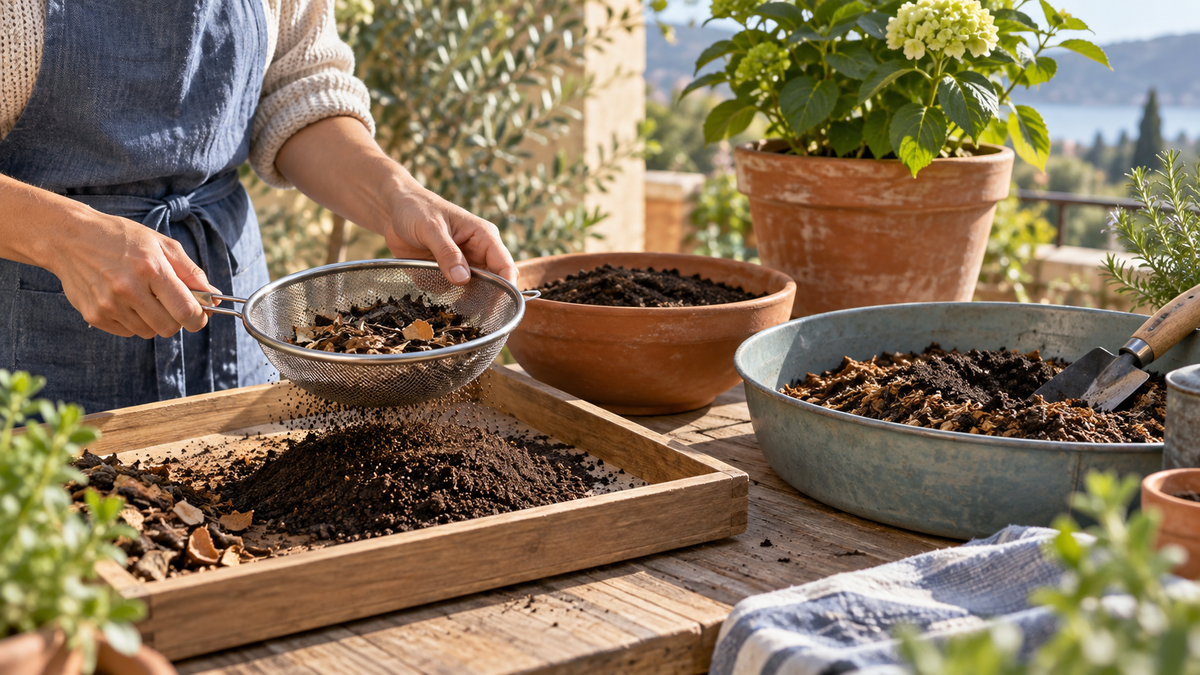
Follow one GEME application path: screen → return suitable unfinished pieces → mix approximately 1:8 with plain soil → cap with soil → water and observe.
Keep concentrated material away from direct root contact. Retain the required starter bed when harvesting. Further maturation may suit applications needing a more stable material.
Real composting does not mean every new addition or freshly harvested piece has the same maturity. The official GEME application guide explains this continuous-flow handling. Avoid sealed, airless storage for moist Compost Base; use the guide’s breathable storage route.
Before garden use: a five-question check
- Which device produced it? Keep the brand output name with the container.
- Which mode and inputs? Note food-only versus any approved packaging batch.
- What preparation is specified? Check screening, mixing rate, application depth and any waiting period.
- Where will it go? A lawn, empty bed, planted pot, compost pile and collection bin are different destinations.
- Do the instructions fit this planting task? Do not use concentrated appliance output as a substitute for seed-starting or potting medium.
If the mode is unknown or instructions conflict, keep the material separate from plants and ask the producing brand for the correct route. Never resolve uncertainty by borrowing a more generous ratio from another machine.
If something looks wrong, choose the next step
| Situation | Next step |
|---|---|
| You forgot the mode | Identify the device and batch history before plant use; check with the manufacturer if uncertain. |
| Output has large unfinished pieces | For GEME, screen and return suitable pieces to the chamber. Use each other brand’s own handling advice. |
| You have excess material | Follow that brand’s storage method. A dry recycler output and moist microbial base need different storage conditions. |
| You mixed different brands’ outputs | Do not assume one published ratio covers the blend. Keep future batches separate; obtain application advice for the mixed material. |
| You want to feed output to worms or another appliance | Compatibility needs its own evidence. Do not transfer processed output into GEME or a worm bin by default. |
| An organics program is the destination | Check the local operator’s accepted materials, particularly for batches containing packaging. |
Choose Real Microbial Composting at Home
Turn suitable kitchen scraps into Compost Base through GEME’s continuous biological process. Choose your model by daily load, then follow the official soil-use guide.

Choose the GEME model by your kitchen load
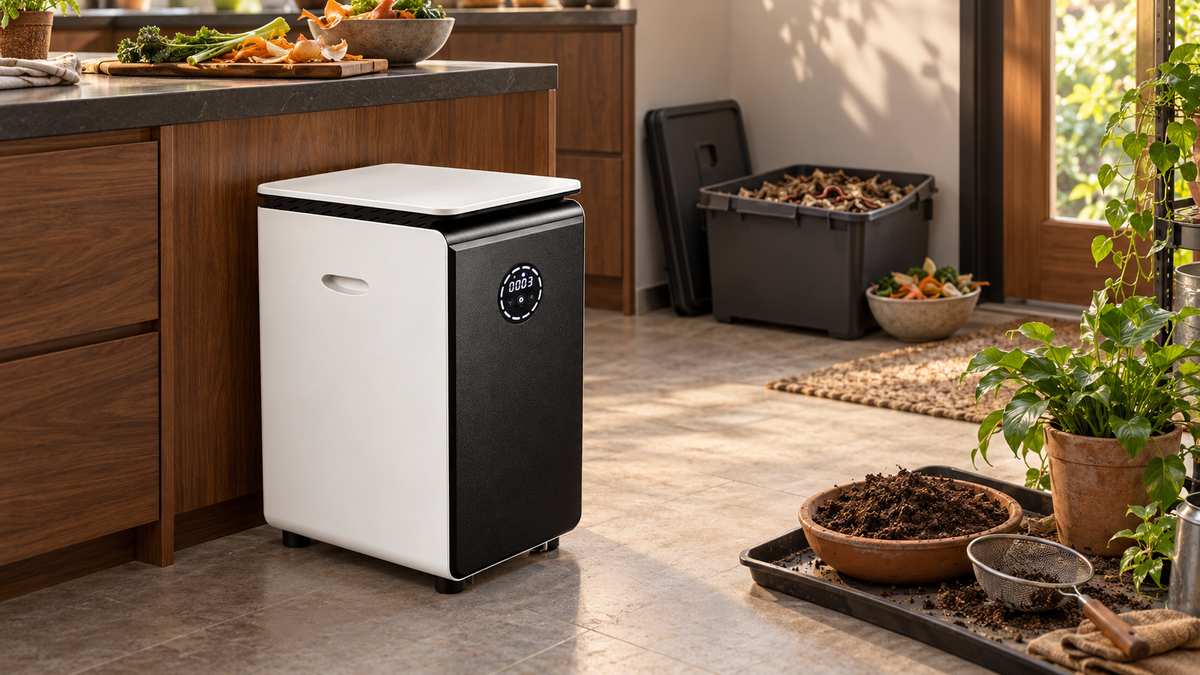
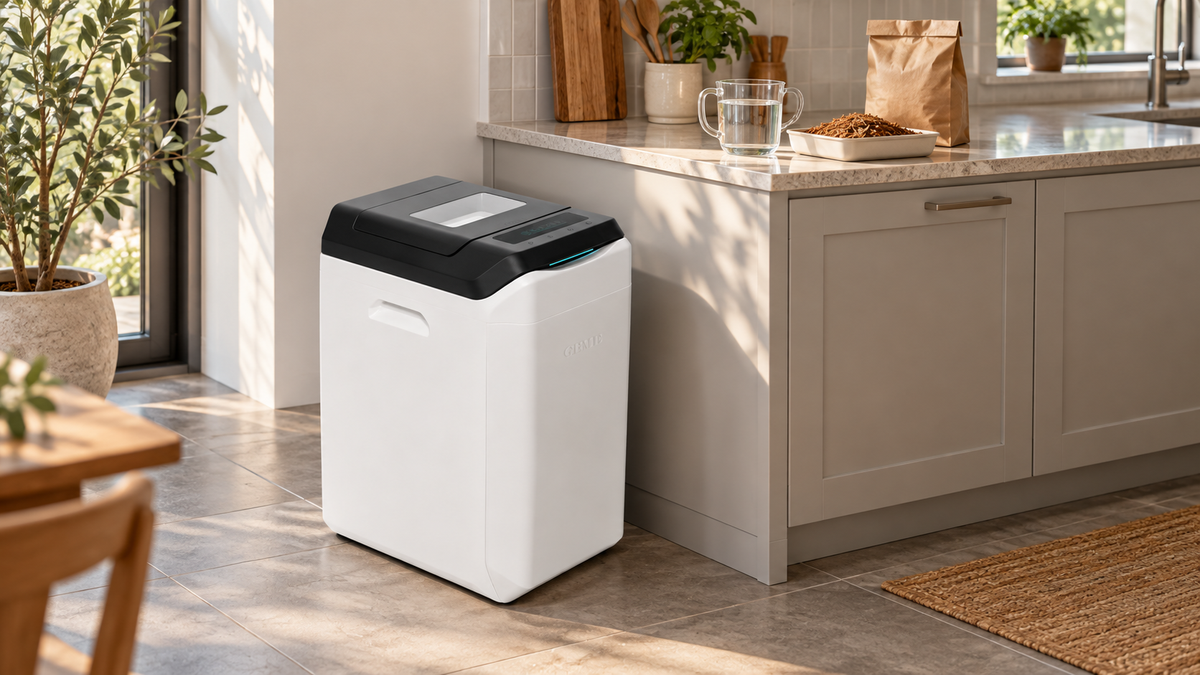
If your goal is real microbial composting indoors, choose the GEME capacity that fits your daily scraps. Both models use a continuous microbial bed and share the Compost Base application approach. The model choice is about workload, not a different permission to use output pure.
| Model | Daily input capacity | Chamber | Each addition | Typical fit |
|---|---|---|---|---|
| GEME Terra 2 | Up to 2 kg/day | 14 L | 1 kg or less | Smaller households and lighter cooking loads |
| GEME Pro | Up to 5 kg/day | 19 L | 1 kg or less | Larger households and heavier cooking loads |
Place either model on a suitable indoor floor with clear access and ventilation. Use Terra 2 for the lighter workload or GEME Pro for recurring higher loads. Electricity and routine care remain part of ownership even without scheduled replacement odor filters.

Frequently asked questions
Can I use Lomi, Mill, Vego and GEME output in the same way?
No. Use the producing brand’s instructions for the exact model, mode, ingredients and destination. Output names and soil-like appearance do not establish equivalent maturity or application rates.
Does the selected mode change the output instructions?
Yes. Lomi and Vego describe mode-dependent outputs and uses. GEME Terra 2 and Pro instead maintain a continuous microbial bed; harvested Compost Base follows GEME’s screening and application guidance.
Are Mill Food Grounds already compost?
Mill states that Food Grounds are not yet compost. Its soil-incorporation guide uses approximately 1:75 by volume and at least two weeks before planting. Further composting is another route.
Can I use GEME’s 1:8 ratio for Lomi or Mill output?
No. GEME’s ratio belongs to GEME Compost Base and its application instructions. Do not transfer it to another brand’s output.
Does every Vego mode produce the same Vego Meal?
The same name is used across modes, but processing and recommended destinations differ. Identify the mode and follow its specific output guidance; ask Vego when public instructions conflict.
Is GEME Compost Base the same as potting soil?
No. GEME Compost Base comes from real microbial processing but is prepared as a soil amendment. Screen unfinished pieces, mix with plain soil under GEME guidance and cap with soil for the intended planting use.
Can I put another recycler’s output into GEME?
Do not assume that processed recycler output is an approved GEME input. Keep the material on its producing brand’s application or disposal route unless GEME support confirms compatibility.
What finishing step should I use before planting?
Use the step specified for your material and destination: this may be further composting, a waiting period after soil incorporation, or GEME’s screen, return, mix and cap workflow. No single waiting period or dilution ratio applies to every output.
Sources and product information
Manufacturer guidance checked October 13, 2026. Mode availability and instructions can vary by model or revision. This is a comparison of published instructions, not a laboratory maturity test.
- Lomi: current modes and output use
- Lomi: soil mixing and curing
- Mill: Food Grounds soil incorporation
- Vego: modes and optional VegoTabs
- Vego: mode-specific output destinations
- US EPA: home composting and preprocessing
- GEME: Compost Base application guide
- Terra 2: product specifications
- GEME Pro: product specifications


Commenta
Nota che i commenti devono essere approvati prima di essere pubblicati.
Questo sito è protetto da hCaptcha e applica le Norme sulla privacy e i Termini di servizio di hCaptcha.