


Climate Hub · Gardening Hub · Food Waste & Composting
El Niño 2026 Is a Climate Stress Test: Why Food Waste Matters
El Niño 2026 is no longer sitting at the edge of a long-range forecast. The tropical Pacific Ocean and atmosphere are now operating as a coupled El Niño system, and NOAA says the event is strengthening rapidly.
NOAA's August outlook gives a greater than 90% chance of a very strong El Niño during Northern Hemisphere fall and winter 2026–27. For October through December, NOAA also gives a 69% chance that the Relative Oceanic Niño Index reaches at least +2.5°C—a level that could exceed previous El Niño events in NOAA's record dating to 1950.

That forecast has revived widespread interest in a possible super El Niño. “Super El Niño” is not an official NOAA category; the formal terminology is very strong El Niño, but the public phrase captures an important reality: 2026 may produce an unusually consequential climate event.
The bigger question is what happens when one of Earth's most powerful natural climate oscillations unfolds in an already warmer world, and what that tells us about floods, drought, heat, agriculture, food systems and the emissions we can still avoid.
Quick Answer: Why Does El Niño 2026 Matter Beyond the Weather Forecast?
El Niño changes atmospheric circulation and therefore changes the probability and location of extreme rainfall, drought, heat and tropical cyclone activity.
Those climate shifts then reach agriculture, water supplies, food prices, infrastructure and public health.
Composting cannot control El Niño or La Niña. But climate resilience requires two things at the same time: adapting to climate extremes and reducing avoidable greenhouse-gas emissions.
Keeping suitable food scraps out of high-methane landfill pathways, and returning appropriately processed organic matter to soil, is one part of that broader climate response.
Table of Contents
- What Is El Niño?
- What Is the El Niño 2026 Forecast?
- How El Niño Changes Extreme Weather Risk
- From Weather to Agriculture, Food & the Economy
- Why Food Waste Is a Methane Problem
- The “Kitchen Composter” Definition Problem
- Why Drying Food Is Not the Same as Composting
- The Climate Claim Depends on the Final Pathway
- What Real Composting Adds: A Soil Pathway
- Household Technology Is Beginning to Reflect the Difference
- Where GEME Fits—and Where It Does Not
- What This Has to Do With El Niño
- Why Clear Definitions Matter
- Frequently Asked Questions
- Sources & Scientific References
1. What Is El Niño?
If you are asking what is El Niño, the starting point is the tropical Pacific Ocean.
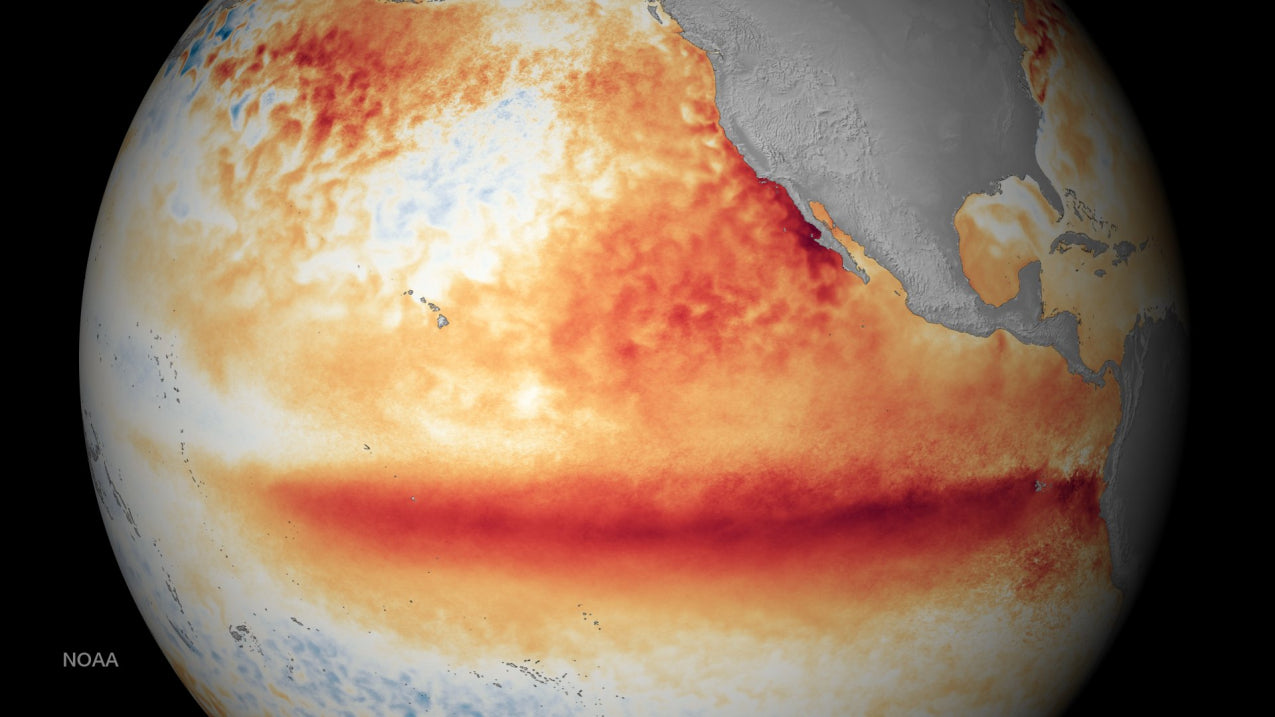
El Niño is the warm phase of the El Niño–Southern Oscillation, or ENSO, a recurring interaction between tropical Pacific ocean temperatures and the atmosphere.
NOAA describes ENSO as one of the most influential climate drivers on Earth.
During El Niño:
- central and eastern equatorial Pacific waters become unusually warm;
- trade winds weaken;
- tropical rainfall shifts eastward;
- ocean heat is released into the atmosphere in different locations;
- large-scale atmospheric circulation changes;
- jet streams and storm tracks can shift thousands of miles away.
The result is not one universal type of El Niño weather.
Instead, El Niño alters the probability of particular temperature, precipitation and storm patterns across different regions and seasons.
NOAA's detailed introduction is available at Understanding El Niño & ENSO.
2. El Niño 2026 Forecast: How Strong Could It Become?
The El Niño 2026 forecast has strengthened dramatically.
NOAA's Climate Prediction Center reported on August 13 that the ocean and atmosphere were clearly coupled in a strengthening El Niño state.
Its official synopsis is straightforward:
El Niño is strengthening, with a greater than 90% chance of a very strong event during Northern Hemisphere fall and winter 2026–27.
For October–December 2026, NOAA also gives a 69% chance that RONI reaches +2.5°C or higher.
NOAA says such an outcome could exceed the strength of previous El Niño events in the record dating to 1950.
This is why super El Niño has become a prominent public search term.
“Super El Niño” is an informal description, not an official NOAA classification. NOAA's formal language for the expected 2026–27 event is very strong El Niño.
Follow NOAA's official ENSO Diagnostic Discussion for the latest El Niño forecast.
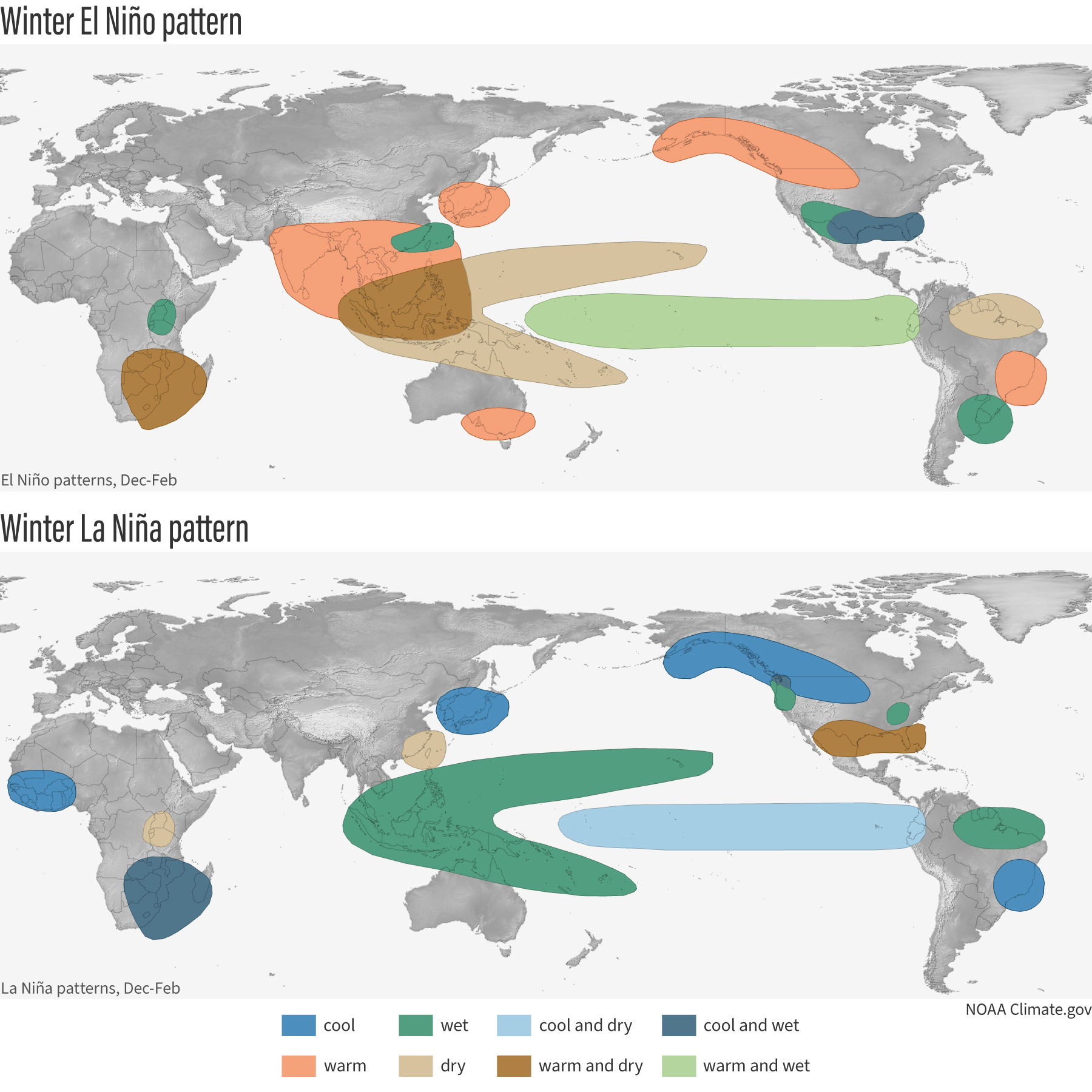
3. How El Niño Changes Extreme Weather Risk
El Niño is more than a temperature anomaly in one part of the Pacific.
By reorganizing tropical rainfall, pressure patterns and jet streams, it can change the probability and location of high-impact weather.
NOAA researchers explicitly connect ENSO forecasting with efforts to anticipate drought, wildfire, flooding and food-security threats.
But the scientific wording matters.
El Niño changes the odds of extreme events. It does not mean every flood, heatwave, drought or hurricane during an El Niño year was caused by El Niño.
For household and garden preparation during dangerous heat, see GEME's Extreme Heat Warning: Safety, Garden & Composting Guide.
If severe storms or flooding have already affected your area, use Recovery Tips After a Hurricane for floodwater, food, garden and compost-safety boundaries.
4. A Climate Event Becomes an Agriculture, Food and Economic Event
Agriculture is one of the clearest examples of how ENSO moves from climate science into everyday life.
Too little rain can affect:
- soil moisture;
- crop establishment;
- irrigation demand;
- reservoir supply;
- livestock water availability;
- yield and harvest timing.
Too much rain creates a different set of problems:
- waterlogged roots;
- soil erosion;
- crop disease;
- delayed harvesting;
- transport disruption;
- flood damage.
Heat adds another layer through crop and livestock heat stress.
These shocks can move from farms into food prices, commodity markets, insurance losses, transport systems and household budgets.
A 2023 study in Nature Communications estimated that the economic effects of major El Niño events can persist for years. Under the authors' statistical framework, cumulative losses associated with the 1997–98 El Niño reached about $2.1 trillion, while the 2015–16 event was associated with about $3.9 trillion over the event year and following three years.
Those figures are model estimates rather than direct disaster-loss accounting, but they show why ENSO belongs in conversations about economic and food-system resilience.
Read the peer-reviewed study: Nonlinear El Niño Impacts on the Global Economy Under Climate Change.
5. Food Waste Is Also a Methane Problem
At first glance, the food scraps in an ordinary kitchen have almost nothing to do with an ocean-atmosphere phenomenon spanning the Pacific.
Physically, they do not control ENSO.
But a climate-stressed world forces us to examine both sides of the response:
- adaptation to climate extremes;
- mitigation of avoidable greenhouse-gas emissions.
Food waste belongs in the second conversation.
EPA estimates that food accounts for approximately 24% of municipal solid waste disposed of in U.S. landfills.
Yet landfilled food produces an estimated 58% of fugitive methane emissions from U.S. municipal solid-waste landfills.
The reason is the decomposition pathway.
Food buried in an oxygen-poor landfill environment undergoes anaerobic decomposition, which generates methane.
For a full accounting of landfill methane, transport, composting emissions, electricity and soil-carbon boundaries, read Composting vs Landfill: Environmental Impact.
6. The Household “Kitchen Composter” Market Has a Definition Problem
This is where the consumer food-waste market becomes confusing.
Products using fundamentally different processes are frequently grouped under the same label:
“Electric composter.”
One machine may maintain an aerobic microbial environment in which biological decomposition occurs.
Another may primarily:
- heat food scraps;
- remove water;
- grind the remaining material;
- reduce volume and weight.
Those processes can both have practical value.
But they should not be described as biologically or environmentally identical.
EPA defines composting as:
managed, aerobic biological decomposition of organic materials by microorganisms.
EPA then makes a separate point about residential pre-processing appliances:
Food-scrap grinders and dehydrators reduce weight and volume, but they do not produce compost. Their dried material still requires composting, curing or another appropriate downstream treatment.
See EPA's Composting at Home guidance and EPA's Approaches to Composting.
7. Making Food Waste Smaller Is Not the Same as Composting It
A dehydrator can reduce the physical problem of wet kitchen scraps.
Removing water can:
- reduce weight;
- reduce storage volume;
- make transport easier;
- reduce some everyday odor and mess.
But the climate outcome still depends on where that material goes next.
If the dry material is ultimately placed in general trash and sent to landfill, the appliance has reduced the material's mass and water content—but has not necessarily completed landfill diversion.
That leads to one of the most important principles in household waste technology:
For the broader process comparison, see Compost Pile vs Electric Composter.
8. The Climate Claim Depends on What Happens Next
Environmental claims need complete system boundaries.
Consider two households.
One dries food scraps and then places the dry material into general trash.
The other separates unavoidable food scraps and moves them into a well-managed composting pathway.
Both may have reduced the visible volume of food waste in the kitchen.
Only the second has clearly changed the final waste-management pathway.
Energy use must also be counted.
Thermal dehydration requires electricity. Managed composting can also use electricity or fuel. Transport creates emissions. Poorly aerated compost can generate methane and nitrous oxide.
That is why a lifecycle assessment cannot stop at the name of the appliance.
A review and meta-analysis of 82 studies, mostly lifecycle assessments, published in Waste Management, concluded that aerobic composting and anaerobic digestion were environmentally preferable to waste-to-energy and landfill-gas-to-energy for climate-change impacts among the pathways for which sufficient comparative evidence existed.
The authors also emphasized wide differences in study boundaries and found that no single end-of-life option performed best across every environmental category.
Read the research at PubMed: Review and Meta-Analysis of 82 Organic-Waste Management Studies.
9. What Real Composting Adds: A Soil Pathway
Avoiding landfill methane is only one side of composting.
The other is what happens when appropriately finished compost returns to land.
EPA's 2025 scientific review concludes that the overarching research consensus supports compost as a tool for improving soil health.
The agency identifies benefits including:
- higher soil organic matter;
- improved water-holding capacity;
- better water infiltration and retention;
- lower soil density and compaction;
- reduced stormwater runoff;
- reduced erosion;
- greater resilience to heat, drought and floods.
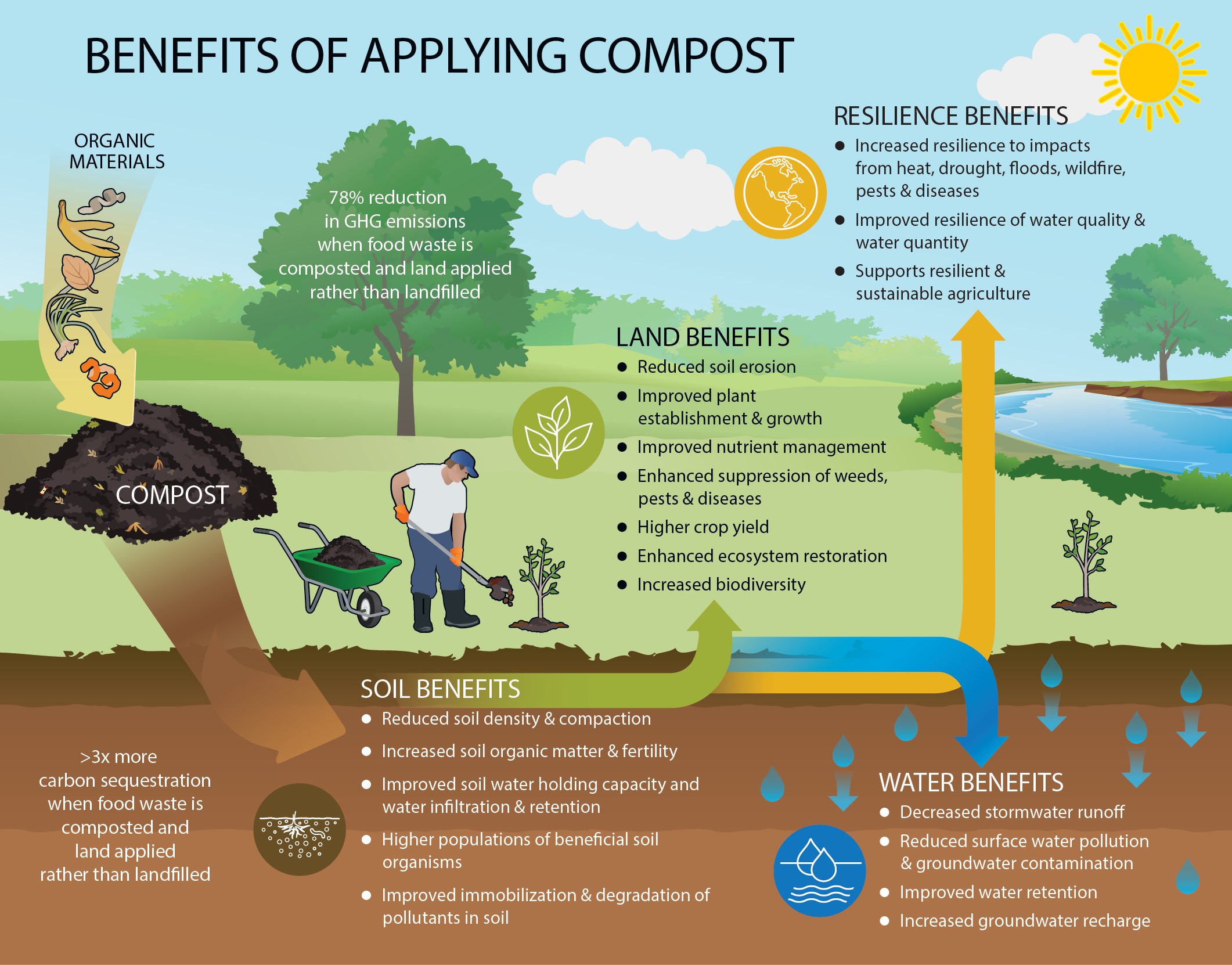
EPA's synthesis reports approximately a 78% reduction in greenhouse-gas emissions when food waste is composted and land applied rather than landfilled across the pathway studies it reviewed.
It also reports more than three times greater carbon sequestration in that comparison.
These numbers describe defined waste-management pathways in EPA's scientific synthesis. They should not be copied directly into a product claim for any household appliance.
For practical soil use rather than carbon accounting, read How to Use Compost Correctly.
For GEME Compost Base specifically, follow the Advanced GEME Compost Application Guide.
10. Household Technology Is Beginning to Reflect the Difference
The distinction between dehydration and biological composting is no longer confined to waste-management literature.
Consumer technology is beginning to move in both directions.
At IFA 2024 in Berlin, Digital Trends included the GEME Terra II among its selections for the best smart-home technology of the show.
The publication highlighted its sensor monitoring, automated adjustment of the composting environment and filtration approach.
Read the original independent coverage: Digital Trends — The Best Smart Home Tech of IFA 2024.
That recognition is useful because it shows microbial household composting entering the broader smart-home technology conversation.
More important, however, is what happened when the next-generation Terra 2 was actually tested in a household.
In 2026, Digital Trends conducted a multiweek household test of GEME Terra 2 and explicitly distinguished its microbial-decomposition approach from food recyclers that primarily dry and grind scraps. Terra 2 and the higher-capacity GEME Pro both use Continuous Aerobic Microbial Composting, maintaining a living microbial environment with managed heat, moisture, airflow and mixing rather than relying mainly on dehydration.
The two systems apply the same biological approach at different household scales. Terra 2 is optimized for households of 1–3 people and up to 2 kg of food scraps per day, while GEME Pro is designed for households of 4+ people and heavier daily loads, with capacity of up to 5 kg per day. Digital Trends tested Terra 2 in a five-person household, above the recommended household size for that model. The review is therefore useful not only for confirming the system’s microbial-decomposition approach, but also for illustrating why matching processing capacity to household food-waste volume matters in a continuous aerobic system.
Read GEME's summary of the independent test: GEME Terra 2 Reviewed by Digital Trends.
A separate compost-focused test is available at GEME Terra 2 Reviewed by Compost Magazine.
11. Where GEME Fits, and Where It Does Not
GEME Terra 2 is designed as an automated, powered, continuous aerobic microbial system for suitable household food scraps.
Rather than relying primarily on a short heat-and-grind cycle, the system maintains an active biological environment and uses GEMEBrain™ to manage operating conditions around:
- airflow;
- heat;
- moisture-related conditions;
- mixing;
- continuous microbial activity.
Its output is a moist, microbe-active Compost Base intended for responsible soil integration rather than dried food flakes.
For input boundaries, see What Can You Compost at Home?.
But this process does not justify saying:
- GEME reduces El Niño;
- GEME can regulate La Niña;
- Terra 2 automatically reduces carbon emissions by 78%;
- every powered home composter is always lower-carbon than every municipal alternative.
Research supports the broader proposition that keeping suitable food waste out of landfill pathways and composting organic material can reduce landfill-methane exposure and support soil resilience. A product-specific net-carbon claim for Terra 2 would require lifecycle accounting for electricity, grid mix, manufacturing, logistics, product life, actual food-waste diversion, the displaced waste-management pathway and final Compost Base use.
This is why GEME's Composting vs Landfill analysis separates general pathway evidence from product-specific claims.
12. What Does Any of This Have to Do With El Niño?
At the physical level, composting and El Niño belong to different systems.
Composting does not change Pacific trade winds.
It cannot change the thermocline.
It cannot stop a super El Niño, weaken an El Niño event or prevent La Niña from developing later.
The connection exists at the climate-response level.
The adaptation side asks how we build soils, landscapes and food systems that can better tolerate drought, heat and intense rainfall.
The mitigation side asks which avoidable emissions we can reduce.
Keeping suitable organic material out of high-methane landfill pathways belongs to mitigation.
Using appropriate compost to improve soil water retention, infiltration and organic matter belongs to resilience and adaptation.
Neither controls ENSO.
Both make sense in a world where natural climate variability operates on top of long-term anthropogenic warming.
13. Clear Definitions Are Part of Better Climate Decisions
Climate action is often discussed through enormous systems:
- power generation;
- transport;
- agriculture;
- industry;
- buildings.
Those systems deserve attention.
But smaller material flows still matter.
Food is produced using land, water, fertilizer, energy, refrigeration, labor and transport.
Once edible-food prevention and reuse have been exhausted, the remaining organic material still has to go somewhere.
The useful questions are:
- What process actually occurred?
- Was the material biologically decomposed or simply dried?
- Where did the resulting material go?
- Was landfill disposal genuinely avoided?
- Was organic matter returned to a productive soil pathway?
- What energy and transport were required?
A dehydrator can be useful.
A food recycler can be useful.
A microbial composter can be useful.
But those words should not be treated as interchangeable.
In environmental accounting, the distinction is not simply what the machine is called. It is what process occurred and where the material ultimately went.
Climate Mitigation + Soil Resilience
We Cannot Control El Niño. We Can Make Better Choices Around It.
The practical response to climate variability is not to promise control over ENSO. It is to reduce avoidable emissions, keep suitable organic material out of landfill pathways where practical, build healthier soils and describe environmental technologies honestly.
14. El Niño 2026, Food Waste & Composting FAQ
What is El Niño?
El Niño is the warm phase of the El Niño–Southern Oscillation, a recurring coupled ocean-atmosphere pattern in the tropical Pacific. It can alter rainfall, temperature, wind and storm patterns around the world.
What is the El Niño 2026 forecast?
NOAA's August 2026 outlook gives a greater than 90% chance of a very strong El Niño during Northern Hemisphere fall and winter 2026–27. The event is expected to continue strengthening through the end of 2026.
Is a super El Niño expected in 2026?
“Super El Niño” is not an official NOAA category. NOAA currently describes the event as highly likely to become very strong and gives a 69% chance that the October–December 2026 RONI reaches +2.5°C or higher.
Does El Niño cause floods, heatwaves and drought?
El Niño changes atmospheric circulation and therefore changes the probability and location of floods, drought, heatwaves and other weather extremes. It should not be treated as the sole cause of every individual event occurring during an El Niño year.
Does El Niño increase hurricanes?
Not everywhere. El Niño usually increases vertical wind shear over the tropical Atlantic, suppressing Atlantic hurricane activity on average, while conditions can become more favorable for tropical cyclones in parts of the central and eastern Pacific.
Why does food waste create methane in landfills?
Food buried in landfills decomposes under low-oxygen conditions. Anaerobic decomposition generates methane, which is why EPA identifies landfilled food as a disproportionately large source of fugitive landfill methane.
Are electric food dehydrators actually composters?
EPA distinguishes residential grinders and dehydrators from composting systems. Dehydrators reduce the weight and volume of food scraps, but the resulting dried material is not compost and generally needs further composting, curing or another appropriate treatment pathway.
Does dehydrating food waste reduce landfill emissions?
Not automatically. Dehydration may reduce weight and transport volume, but the climate outcome depends on energy use and what happens to the dried material afterward. If it ultimately enters a landfill, dehydration alone does not prove landfill diversion.
Does composting reduce greenhouse-gas emissions?
Compared with landfilling food waste, well-managed composting can reduce greenhouse-gas impacts under many lifecycle scenarios. EPA's current literature synthesis reports substantial pathway-level benefits, while exact results depend on transport, energy, process emissions, landfill conditions and final compost use.
Can compost improve climate resilience?
Yes. EPA's scientific review links appropriate compost use with better soil water holding capacity, infiltration, organic matter and reduced runoff, which can help soils cope with drought and intense rainfall.
Can composting reduce El Niño or La Niña?
No. ENSO is a large-scale Pacific ocean-atmosphere cycle. Composting cannot control its onset or strength. Composting instead contributes to climate mitigation and resilience through waste diversion and soil improvement.
Is GEME Terra 2 different from a food-waste dehydrator?
Terra 2 is designed around continuous aerobic microbial processing rather than a process based primarily on drying and grinding. It maintains an active microbial environment and produces a moist Compost Base intended for responsible soil blending.
Does GEME Terra 2 reduce carbon emissions by 78%?
That should not be claimed. EPA's 78% figure is a pathway-level literature synthesis comparing food waste that is composted and land applied with landfilling. It is not a lifecycle assessment of GEME Terra 2.
15. Sources & Scientific References
- NOAA — Understanding El Niño & ENSO
- NOAA Climate Prediction Center — ENSO Diagnostic Discussion, August 13, 2026
- NOAA CPC — Official ENSO Strength Probabilities
- NOAA GFDL — August 2026 Experimental El Niño Predictions
- NOAA Physical Sciences Laboratory — ENSO Information & Research
- Nature Communications — Nonlinear El Niño Impacts on the Global Economy Under Climate Change
- U.S. EPA — Quantifying Methane Emissions from Landfilled Food Waste
- U.S. EPA — Composting at Home
- U.S. EPA — Approaches to Composting and Food-Scrap Pre-Processing
- U.S. EPA — Environmental Value of Applying Compost
- Morris, Matthews & Morawski — Review and Meta-Analysis of 82 Organic-Waste Management Studies, Waste Management
- Digital Trends — The Best Smart Home Tech of IFA 2024
- Digital Trends — GEME Terra 2 Real-World Review, June 2026
Climate and ENSO forecast information reviewed August 26, 2026. “Super El Niño” is used as an informal public term; NOAA's formal category is “very strong El Niño.” EPA composting and landfill figures describe defined waste-management pathways and should not be interpreted as a product-specific GEME Terra 2 lifecycle assessment.


Laat een reactie achter
Alle reacties worden gemodereerd voordat ze worden gepubliceerd.
Deze site wordt beschermd door hCaptcha en het privacybeleid en de servicevoorwaarden van hCaptcha zijn van toepassing.