


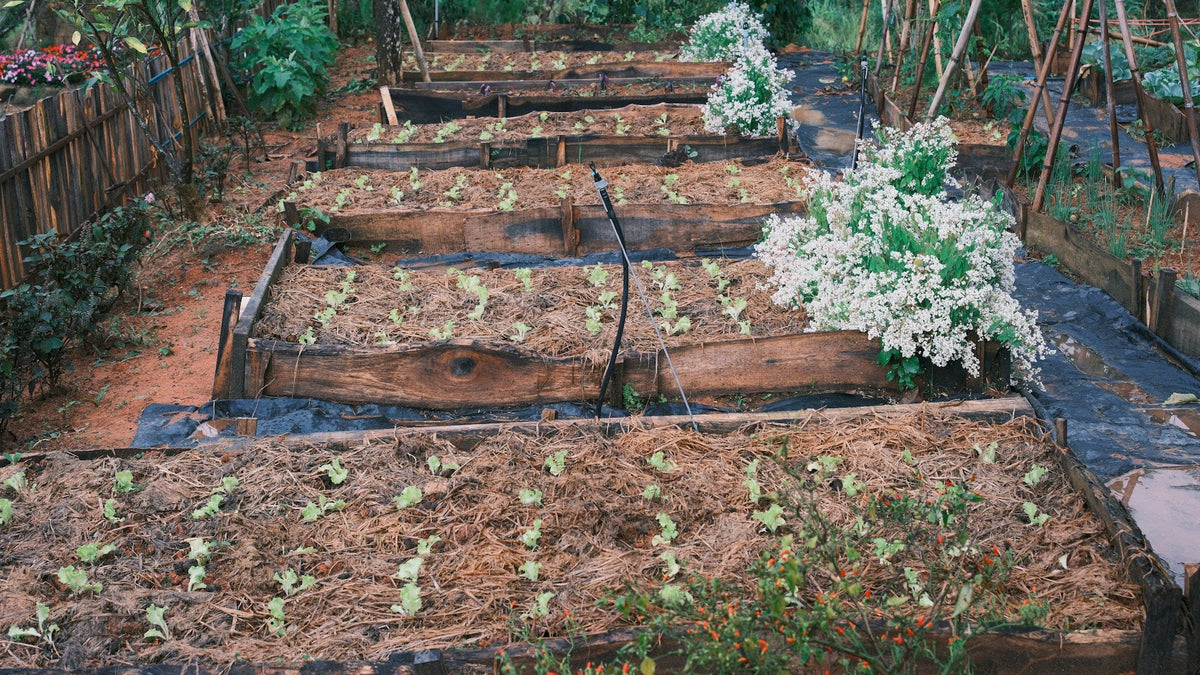
Raised Beds · Root Zones · Soil Care
A successful raised garden bed starts with usable root space, drainage, and a soil mix suited to the site.
Choosing the frame is one decision. How deep should the bed be? What belongs at the bottom? How much soil should you order, and when does compost belong in the mix?
This guide walks through building, filling, and maintaining a raised bed, with practical examples for both new beds and established vegetable gardens.

Quick Answer: How Do You Start a Raised Garden Bed?
- Choose a suitable site. Check sunlight, access to water, and where excess water will drain.
- Size the bed for the gardener and the crops. You should be able to reach the planting area from the paths.
- Assess what is underneath. An open-bottom bed on soil and a planter with a solid base need different root-zone planning.
- Calculate the fill volume. Use the inside dimensions and the intended soil depth.
- Choose an appropriate soil mix. Add compost according to its condition and the soil's needs.
For related soil and planting topics, use the Gardening Guide.
1. Is a Raised Garden Bed Right for My Garden?
A raised bed is useful when you want a defined growing area and more control over its soil and access. It can be a framed bed sitting on the ground, an unframed mound, or a planter with its own base.
An open-bottom bed allows roots to continue into suitable soil underneath. A planter on legs has a fixed growing volume. Before choosing either, decide what you want to grow and how you will reach, water, and maintain it.
- Good existing garden soil: improving an in-ground bed may already meet your needs.
- Limited comfortable reach: bed width and path access become priorities.
- A paved growing area: plan the available rooting depth, drainage outlets, and a suitable contained growing medium.
Check the location at several times of day. Fruiting vegetables such as tomatoes and peppers generally need a sunny position; University of Minnesota Extension recommends at least six to eight hours of sun for these crops in its raised-bed guidance. A frame cannot compensate for a site that does not meet the crop's light needs.
2. How Do I Build a Raised Garden Bed That Fits My Space?
Mark the footprint and test your reach before buying the frame or ordering soil. Use string or a garden hose to outline the bed and its paths. Make sure gates, taps, and regular walking routes remain usable.
Choose Width by Reach
A bed about 3 to 4 ft wide, approximately 0.9 to 1.2 m, can be practical where both sides are accessible. Use a narrower bed against a wall. The useful width is the one that lets you tend the middle without stepping into the growing soil.
Choose Depth by the Whole Root Zone
Measure the usable soil below the frame as well as the soil inside it. A modest frame over deep, workable ground can provide more root space than a taller box over an impenetrable base. For a planter with a bottom, the contained medium must provide the required depth on its own.
Match that depth to the crops and varieties you intend to grow. A 12-inch fill depth is useful for the volume examples below; it is not a universal minimum or a guarantee that every crop has enough root space.
Assemble Around a Level, Accessible Site
- Mark the inside bed dimensions and working paths.
- Prepare the surface and position the frame level.
- Check corners, fasteners, and any bracing specified by the manufacturer or building plan.
- Confirm the base treatment and drainage before filling.
Wood, metal, masonry, and other purpose-made materials offer different assembly and maintenance options. Choose materials intended for the project and follow the supplied construction guidance. The University of Maryland building guide explains framed beds, paths, and material options.
3. What Should I Put at the Bottom of My Raised Garden Bed?
Start with the surface beneath the bed. There is no single bottom layer suited to soil, persistent turf, and paving.
| Bed location | Main task | What to check |
|---|---|---|
| Workable garden soil | Maintain a connection between the added mix and the ground. | Compaction, drainage, and existing soil condition. |
| Grass or persistent weeds | Deal with the vegetation before planting. | Whether the chosen removal or smothering method will work before planting time. |
| Concrete, paving, or a solid planter base | Provide a complete root zone and a drainage route. | Actual medium depth, drainage openings, and where water exits. |
Cardboard is sometimes used to smother vegetation, but it is not a universal drainage layer. Maryland describes smothering approaches, while Minnesota notes that cardboard can impede infiltration until it breaks down. Select the method for the site and timing; see the university guidance on preparing the soil beneath a bed.
In a deep frame, bulky organic fill can reduce the initial amount of purchased soil, but that material will settle as it decomposes. Keep sufficient suitable growing medium in the crop's root zone. A layer of stones or logs should not be treated as a fix for an unresolved drainage problem.
4. What Is the Best Soil for a Raised Garden Bed?
Choose a growing medium that holds useful moisture, releases excess water, and leaves air space for roots. The right starting materials depend on the bed's connection to the ground and the soil already available.
For many ground-connected beds, good-quality topsoil or garden soil provides the mineral framework, and mature compost contributes organic matter. A shallow planter on a solid base may need a medium designed for contained growing, rather than a dense load of field soil.
When comparing bulk blends, ask what is in them and whether the supplier can provide soil or compost test information. A bag labeled “raised bed mix” still needs to suit your site. Existing soil, drainage, and material quality explain why a single percentage recipe will not fit every bed.
The Maryland soil-filling guide organizes recommendations by site condition. Our raised bed soil mix guide compares blend options in more detail.
Already have a productive bed? Check its condition before buying a new load of mix. Topping up lost volume, adjusting a nutrient deficiency, and rebuilding a poorly draining bed are three different jobs.
5. How Much Soil Do I Need to Fill My Raised Garden Bed?
Multiply the inside length by the inside width and the intended fill depth, using the same units. Use inside dimensions because frame thickness does not hold growing medium.
Cubic feet = length in feet × width in feet × fill depth in feet
Liters = length in meters × width in meters × fill depth in meters × 1,000
For cubic yards, divide cubic feet by 27.
A 4 × 8 ft bed filled 12 inches deep needs 32 cubic feet, approximately 906 L or 1.19 cubic yards. The calculation is 4 × 8 × 1, because 12 inches equals one foot.
| Inside bed size | Fill depth | Cubic feet | Approximate liters |
|---|---|---|---|
| 4 × 4 ft | 12 in | 16 | 453 L |
| 4 × 8 ft | 6 in | 16 | 453 L |
| 4 × 8 ft | 12 in | 32 | 906 L |
| 4 × 8 ft | 18 in | 48 | 1,359 L |
How Many Bags Should I Buy?
Divide the required volume by the volume printed on the bag, then round up. For the 906 L example, 50 L bags would require 19 bags to cover the nominal volume. Check that the blend is appropriate before placing the order.
How Do I Calculate a Top-Up?
Measure only the depth you need to restore. A 1-inch top-up over a 4 × 8 ft bed is about 2.67 cubic feet or 76 L. That is a volume calculation, not a recommendation to add that much compost. The material chosen for the top-up still depends on the soil's needs.
6. Can I Fill a Raised Garden Bed With Only Compost?
For a conventional framed raised bed, use a suitable soil mix rather than filling the entire root zone with compost alone. Organic material changes as it decomposes, and the finished growing medium needs workable physical structure as well as nutrients.
Oregon State University Extension specifically recommends a soil mix for framed raised beds. It also explains that compost quality varies with its source and processing.
Mature compost and newly decomposing material have different uses. A material can be dark, finely ground, or screened without being ready for sensitive roots. Compost may also contribute soluble salts and phosphorus, so repeated additions should have a purpose.
For a small raised bed, that distinction matters: the rooting area is finite. Compare the function of each material in our garden soil vs compost guide.
7. When and How Often Should I Add Compost?
Add compost when the soil and planting plan call for it. A seasonal checkpoint is useful; an automatic heavy application every season can miss what the bed actually needs.
| Situation | Useful next step | Check first |
|---|---|---|
| New bed before planting | Plan amendments as part of the initial mix. | Existing ingredients, compost maturity, and soil-test results. |
| Established bed before a new crop | Assess whether a modest addition is needed. | Soil condition and nutrients already present. |
| Plants actively growing | Keep any amendment work clear of stems and avoid disturbing roots. | Whether the issue is nutrients, watering, or another growing condition. |
| After harvest or during an empty period | Review the soil and prepare for the next crop. | Ground moisture, weather, and the next planting date. |
Take soil samples from the bed itself. University of Minnesota Extension recommends more frequent testing when compost or manure is regularly applied, so nutrient accumulation can be tracked.
Keep a simple bed record: crop, amendment, amount, date, and the most recent test. It makes the next decision easier than trying to reconstruct several seasons of additions from memory.

For the seasonal decision in more detail, read when to add compost to vegetable beds. For ongoing care, Minnesota's healthy-soil guide also covers protecting soil, organic matter, and crop rotation.
8. Can I Turn Kitchen Scraps Into Compost for My Raised Beds?
Yes, suitable kitchen scraps can become a soil amendment through a managed biological process. The important step is decomposition under appropriate conditions, followed by preparation for the intended garden use.
The EPA's home-composting guide describes backyard and worm composting. It also distinguishes composting from appliances that only grind and dehydrate scraps. Drying reduces moisture and volume; it does not establish that the material is mature compost.
Where Indoor Microbial Composting Fits
For a household that wants to process daily kitchen scraps indoors, GEME uses a maintained microbial bed. Suitable scraps are added progressively while the biological process continues. This can make collection and processing easier to fit around meals, especially when an outdoor pile is inconvenient to visit.
The harvested material is called GEME Compost Base. Because the system accepts fresh material continuously, output can contain pieces at different stages of breakdown. Its garden use therefore includes screening, appropriate soil blending, and further maturation where needed.
Think of this as a way to connect an existing kitchen routine to soil care. Your initial bed may still need a bulk soil purchase, while later amendments can include suitable material prepared from your household's scraps.
9. How Do I Prepare Homemade Compost Before Using It Around Plants?
Match the material's condition to the intended use before choosing an application amount. Finished compost for a bed mix, a still-active compost base, and a seed-starting ingredient should not be treated as equivalent.
Screening removes large pieces, but particle size alone does not establish maturity. Oregon State's compost-analysis guide explains why maturity and soluble salts matter, particularly for germination and young plants.
An Application Example: GEME Compost Base
- Harvest and screen. Separate larger unfinished organic pieces and return them to the chamber.
- Prepare a measured blend. Follow the official guide's approximate ratio of 1 part Compost Base to 8 parts plain soil, using the same volume measure for both.
- Position the blend appropriately. Use plain soil as a buffer for new plants; around established plants, keep the application clear of stems and crowns.
- Cover, water, and observe. Follow the guide's soil-capping instructions and allow additional maturation when the material or planting use calls for it.
A small preparation example is 1 L of Compost Base plus 8 L of plain soil, producing approximately 9 L of blend before settlement. That is a mixing example, not an instruction to apply the whole amount to one plant or bed.
What If the Bed Already Has Soil and Plants?
Prepare the blend separately. Choose a suitable area away from established stems and avoid excavating through roots. Use only what the bed needs, then cover and water according to the application guide.
For direct sowing or a seedling mix, give maturity particular attention. Read the small-batch curing and seedling preparation guide before including Compost Base in that use.

Use the complete Compost Base application guide for new plants, established plants, soil capping, and storage.
10. What Should I Do When My Raised Beds Do Not Need More Compost?
Let soil needs determine application, even when you have more compost available. Process household scraps and amend a particular bed on different schedules.
Keep surplus Compost Base in an appropriate ventilated container, protected from excess rain, and follow the application guide's storage and maturation advice. Label the material and date so that a newly harvested batch is not confused with one already prepared for planting.
Other suitable garden areas may offer an application route after their soil and plant needs are checked. Sharing prepared material with another gardener can also be useful if its source, condition, and instructions are clear.
Does a Larger Garden Require a Larger Indoor Composter?
Choose the appliance by the suitable kitchen scraps you expect to add each day. Terra 2 has a 14 L chamber and supports up to 2 kg/day; GEME Pro has a 19 L chamber and supports up to 5 kg/day. Both allow additions of 1 kg or less at a time.
These are input limits. They are not daily compost yields or a calculation of how many raised beds an appliance will fill. A large garden with a lightly used kitchen can have a very different processing requirement from a smaller garden with frequent family cooking.
Frequently Asked Questions
Do I need to replace raised bed soil every year?
Usually, a productive bed can be maintained rather than emptied and refilled annually. Assess settlement, drainage, crop performance, and soil-test results, then address the specific need. A small top-up and a complete soil replacement are different tasks.
Does compost replace fertilizer?
Compost contributes organic matter and nutrients, but its composition varies. Use soil-test results and crop requirements to decide whether additional fertilizer is needed. Adding more compost is not a precise substitute for correcting a particular nutrient deficiency.
Why has the soil level in my raised bed dropped?
New fill can settle, and organic materials lose volume as they decompose. Check whether you need to restore growing-medium depth and whether drainage is functioning. Replace lost volume with a suitable mix rather than automatically using concentrated compost for the whole top-up.
Prepare the Material for the Garden You Have
For harvested Compost Base, follow the detailed screening, soil-blending, and planting guidance before adding it to a raised bed.
Sources and Further Reading
- University of Maryland Extension: building raised beds
- University of Maryland Extension: soil to fill raised beds
- University of Minnesota Extension: raised bed gardens
- University of Minnesota Extension: soil testing
- Oregon State University Extension: using compost in gardens
- Oregon State University Extension: compost maturity and analysis
- US EPA: composting at home
Reviewed October 22, 2026. Fill volumes are calculated examples, not measured product yields. Planting decisions should reflect the site, crop, and actual material condition.



Laat een reactie achter
Alle reacties worden gemodereerd voordat ze worden gepubliceerd.
Deze site wordt beschermd door hCaptcha en het privacybeleid en de servicevoorwaarden van hCaptcha zijn van toepassing.