
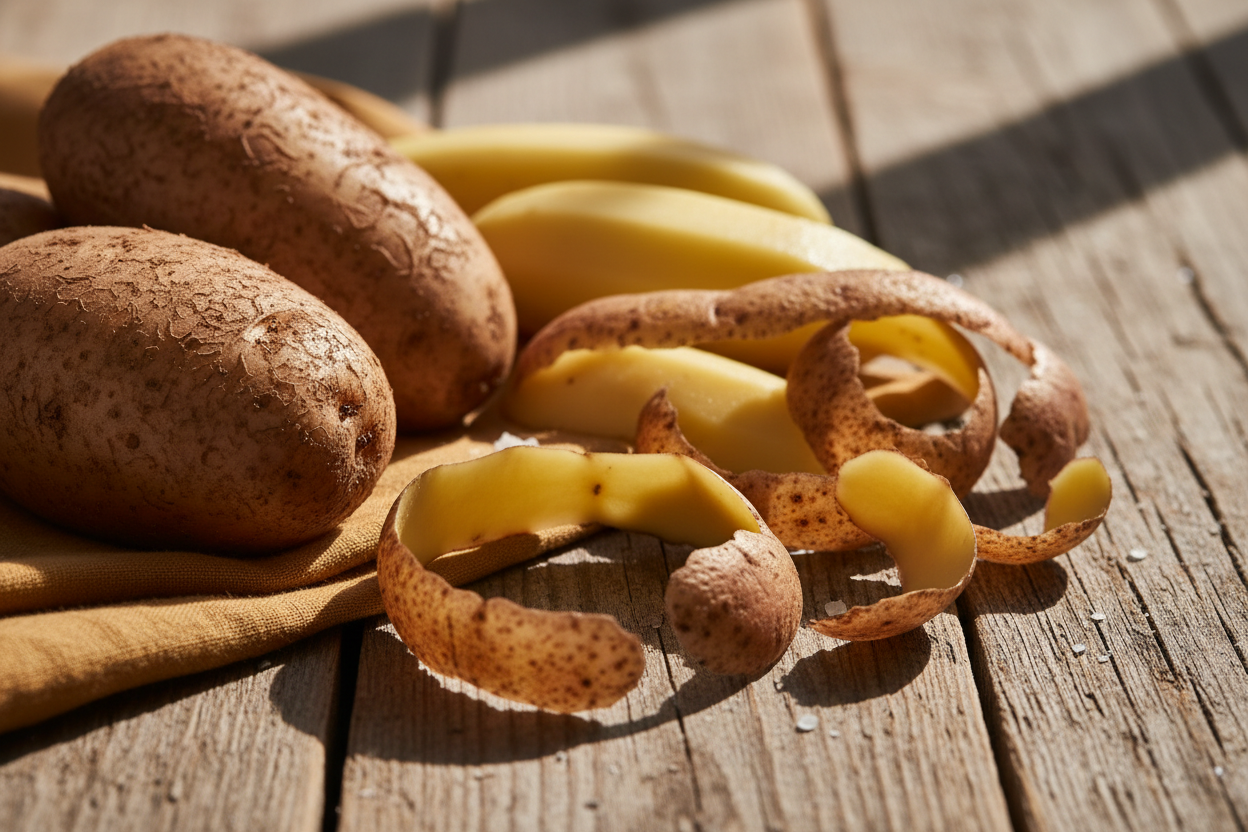
Potatoes · Potato Skins · Sprouted Potatoes · Food Scrap Composting
Can You Compost Potatoes?
Yes. Potato skins, potato peels, cooked or raw potato scraps, and ordinary potatoes that are no longer being eaten can all be composted.
The important distinction is food safety. Fresh, undamaged potato skin can be eaten, but green, strongly sprouting or bitter potatoes may contain elevated glycoalkaloids such as α-solanine and α-chaconine. When a sprouted potato is no longer suitable for eating, cut it into small pieces before composting so more of the dense tuber is exposed to microbial activity.
By Matthew Moore · Last reviewed August 24, 2026

Photo: Buddy AN / Unsplash
Quick Answer: Can You Compost Potato Skins and Peels?
Yes. Potato skins and potato peels are normal compostable vegetable scraps.
Add kitchen peels directly to a well-managed composting system. Whole potatoes are denser, so cut them into smaller pieces before composting. If a potato is green, strongly sprouted or bitter, and you have decided not to eat it, chop it before composting rather than adding the intact tuber.
GEME's broader What Can You Compost at Home? guide specifically includes potato, carrot, cucumber and similar vegetable peelings among materials that break down readily.
Table of Contents
- Can I Compost Potato Skins?
- Can You Compost Potato Peels?
- Can You Eat Potato Skin?
- Are Potato Skins Good for You?
- Can You Eat Sprouted Potatoes?
- Why Can Green or Sprouted Potatoes Be Toxic?
- Can You Compost Sprouted Potatoes?
- How to Compost Potatoes in a Backyard Pile
- Will Potatoes Grow in the Compost Pile?
- What About Potatoes With Blight or Plant Disease?
- Can GEME Terra 2 Compost Potatoes?
- What About Cooked Potatoes?
- Store Potatoes Better Before They Become Waste
- What Happens After Potato Scraps Are Composted?
- Frequently Asked Questions
- Sources
1. Can I Compost Potato Skins?
Yes. Potato skins are easy household compost material.
They are plant tissue containing moisture, carbohydrates and other organic matter that microorganisms can break down.
You do not need to dry potato skins before composting them.
For an outdoor pile:
- add the skins with other vegetable scraps;
- bury them beneath dry brown material;
- mix them rather than leaving one thick wet layer;
- remove produce stickers or other packaging first.
For a complete list of fruit, vegetable and kitchen materials, see What Can You Compost at Home?.
2. Can You Compost Potato Peels?
Yes. In everyday kitchen language, potato skins and potato peels are essentially the same composting material.
Thin peels generally need very little preparation.
If you have unusually long strips from a mechanical peeler, cutting or tearing them shorter can prevent them from matting together in a dense layer.
EPA home-composting guidance treats fruit and vegetable scraps as normal green materials and recommends chopping larger material to support decomposition.
That preparation principle applies even more strongly to a whole potato, because a tuber is much denser than its peel.
If you are new to composting, the Complete Home Composting Guide explains greens, browns, moisture, oxygen and pile management in one place.
3. Can You Eat Potato Skin?
Yes, when the potato is fresh, undamaged and not green.
Potato skin itself is not something that automatically needs to be peeled away.
The German Federal Institute for Risk Assessment specifically says that people who want to eat potatoes with the skin should fundamentally use fresh, undamaged potatoes.
Wash the potato thoroughly before cooking and eating it.
The Answer Changes When the Potato Is Green or Strongly Sprouting
Do not use “potato skin is edible” as a reason to eat green, heavily sprouted, damaged or bitter potatoes. These conditions can be associated with increased glycoalkaloid concentrations.
That distinction is important because glycoalkaloids are concentrated particularly in the potato peel, eyes and sprouts.

4. Are Potato Skins Good for You?
Fresh potato skin can be part of a nutritious potato.
USDA nutrition resources describe potatoes, including their nutrient-rich skin, as sources of:
- potassium;
- vitamin C;
- vitamin B6.
Penn State Extension also notes that potatoes provide dietary fiber, with fiber especially associated with the skin.
Nutrition does not override food safety: the nutritional value of normal potato skin is not a reason to consume green, strongly sprouted or bitter skin.
Preparation matters too.
A baked potato eaten with its skin is nutritionally different from potato skins served primarily as a vehicle for large amounts of salt, saturated fat or highly processed toppings.
5. Can You Eat Sprouted Potatoes?
This answer needs more nuance than a simple yes or no.
A very small sprout on an otherwise firm, non-green potato is not the same condition as an old potato covered in long sprouts.
Some public food-safety guidance allows small sprouts and green portions to be removed before use.
However, the German Federal Institute for Risk Assessment takes a deliberately conservative position:
Old, dried-up, green or strongly germinating potatoes are not suitable for consumption.
For a practical household rule, do not eat a potato when it is:
- strongly sprouted;
- substantially green;
- very shriveled or deteriorated;
- damaged across a large area;
- noticeably bitter;
- or causes a burning sensation in the mouth.
Do not “taste test” a questionable potato repeatedly. Bitter taste can be a warning sign of elevated glycoalkaloids rather than a flavor problem to cook away.
6. Why Can Green or Sprouted Potatoes Be Toxic?
Potatoes naturally contain plant-defense compounds called glycoalkaloids.
The two dominant compounds are:
- α-solanine;
- α-chaconine.
They help the potato plant defend itself against pests and pathogens.
According to BfR, glycoalkaloid levels are particularly concentrated in:
- sprouts;
- the eyes or sprout buds;
- the peel;
- green areas;
- damaged or strongly aging tubers.
The green color itself is chlorophyll and is not the toxin, but greening is an important visual warning that conditions favoring glycoalkaloid accumulation have occurred.
What Can Potato Glycoalkaloid Poisoning Cause?
BfR describes possible symptoms including:
- nausea;
- stomach pain;
- vomiting;
- diarrhea;
- and, in severe poisoning, neurological or cardiovascular effects.
Fortunately, documented severe poisonings are uncommon.
The sensible response is not panic. It is simply to avoid eating potatoes that clearly show the warning signs.

7. Can You Compost Sprouted Potatoes?
Yes, ordinary sprouted potatoes can be composted when they are no longer being eaten.
But do not put an entire dense potato into the compost if simple preparation can make the process easier.
Recommended preparation:
Cut the sprouted potato into small pieces before composting. This breaks open the dense tuber and exposes more internal surface area to moisture, oxygen and microorganisms.
The principle is the same one used throughout composting:
Smaller pieces → more exposed surface → easier microbial access.
The How Does Composting Work? guide explains how microbes, oxygen, moisture and temperature work together after that organic material enters the system.
Does Composting Make the Glycoalkaloid Question Irrelevant?
For household waste handling, the important distinction is that you are no longer planning to eat the potato.
Do not interpret composting as a food-safety “detoxification test.” The goal is simply to redirect suitable organic waste into biological decomposition instead of trying to rescue a questionable potato for the dinner table.
8. How to Compost Potatoes in a Backyard Pile
Potatoes and potato peels fit well into an ordinary backyard pile when they are mixed with other materials.
Potato Peels
Add normally with mixed vegetable scraps.
Whole Potatoes
Cut them into smaller pieces before adding.
Sprouted Potatoes
Cut them into small pieces, bury them in the active pile and cover them with brown material.
Large Quantities
Do not create a thick potato-only layer.
Balance them with:
- dry leaves;
- shredded plain cardboard;
- straw;
- small woody material;
- other appropriate browns.
EPA recommends burying fruit and vegetable scraps and mixing greens with adequate browns to preserve airflow and reduce pest attraction.
For the full process, use the Complete Home Composting Guide.
9. Will Potatoes Grow in the Compost Pile?
They can.
A potato is not simply a dead lump of starch.
The eyes are capable of producing new growth when conditions are suitable.
That is why gardeners intentionally grow potatoes from pieces of seed potato containing viable eyes.
Cutting a potato helps decomposition but does not sterilize every eye. If a viable fragment survives in a cool or inactive part of an outdoor pile, it may still produce a volunteer potato plant.
To reduce that possibility:
- cut unwanted tubers into smaller pieces;
- bury and mix them into the active compost;
- keep the pile biologically active;
- pull volunteer plants if they appear.
Do not confuse a volunteer potato from ordinary kitchen scraps with a certified seed potato intended for gardening.
10. What About Potatoes With Blight or Plant Disease?
This is different from an ordinary sprouted grocery potato.
If a potato is simply old and sprouting in the pantry, the main issue discussed above is food quality and glycoalkaloids.
If the potato or the original plant is known or suspected to have late blight or another serious plant disease, the problem is plant-pathogen management.
University of Minnesota Extension notes that Phytophthora infestans, the late-blight pathogen, can survive in living potato tissue and cull piles.
Penn State's current late-blight guidance likewise warns that living infected potato material can act as a disease source.
Do Not Treat Diseased Potatoes Like Ordinary Kitchen Peels
When potatoes are known or strongly suspected to carry late blight or another serious garden disease, follow your local Cooperative Extension or plant-disease disposal guidance rather than putting them into ordinary home compost intended for the garden.
GEME's broader home-composting material guide applies the same conservative rule to diseased garden plants because ordinary household piles do not provide a validated pathogen-treatment process.
11. Can GEME Terra 2 Compost Potatoes?
Yes. Potato peels and normal potato scraps are suitable vegetable-based kitchen inputs for GEME Terra 2.
For normal peeling scraps, no special processing is required.
For a whole or sprouted potato:
- decide first whether it is still appropriate for food;
- if it is no longer being eaten, cut it into small pieces;
- add the pieces as part of a varied household food-waste stream;
- avoid making one large potato-only load;
- keep packaging, produce stickers and non-food material out.
Terra 2 rule: potato peels can go in normally. Whole or sprouted potatoes are better cut into smaller pieces first so more of the dense tuber contacts the active microbial bed.
Terra 2 uses a warm, aerated microbial environment rather than simply drying and grinding scraps. Read How GEME Continuous Microbial Composting Works.
For the broader material framework, including meat, dairy, bones, hard objects and liquid limits, see What Can You Put in an Electric Composter?.

From Potato Peels to a Microbial Compost Base
Peels Go In. Dense Tubers Get Cut First.
Terra 2 processes suitable kitchen scraps in a continuous microbial bed.
Potato skins and peeling scraps need little preparation. Whole or sprouted potatoes benefit from being cut into smaller pieces before entering the system.
Explore GEME Terra 2 →12. Can You Compost Cooked Potatoes?
The potato itself is biodegradable.
What matters is what has been added to it.
For Terra 2, ordinary mixed leftovers are different from pouring large quantities of free oil or salty liquid into the chamber.
Use the Electric Composter Salt & Oil Boundaries guide for potato dishes containing significant oil, gravy or sauce.
13. Store Potatoes Better Before They Become Waste
Composting should not be the first destination for potatoes that are still suitable for food.
Light and unsuitable storage conditions encourage:
- greening;
- sprouting;
- shriveling;
- quality loss.
BfR recommends storing potatoes in a cool, dark and dry place.
Keeping potatoes away from direct light is particularly important because light exposure encourages greening and can accompany higher glycoalkaloid levels. See GEME Potato Storage Guide.
Potatoes also should not simply be piled together with onions in one closed storage basket. The GEME Onion Storage Guide explains why separate, ventilated storage is preferable.
For the broader household sequence, store, use, freeze or preserve where appropriate, then compost unavoidable waste, use the Food Storage & Waste Reduction Guide.
14. What Happens After Potato Scraps Are Composted?
Potato peels do not create a special “potato fertilizer.”
They become one component of a mixed organic feedstock.
For Terra 2, the resulting material should be treated as a moist, biologically active Compost Base, not as pure planting soil.
Before garden use:
- screen recognizable unfinished pieces;
- return suitable unfinished material to the active process;
- mix Compost Base with soil according to current application guidance;
- avoid planting directly into concentrated fresh output.
Use the Advanced GEME Compost Application Guide for the Terra 2-specific workflow.
For general garden beds, pots and raised beds, read How to Use Compost Correctly.
And for first-party evidence showing why mixed household compost should not be treated like standardized fertilizer, continue to the NPK Test of Home Compost Output (N=50).
15. Common Potato Composting Mistakes
Mistake 1: Throwing Potato Peels in the Trash
Ordinary potato peels are straightforward compostable vegetable scraps.
Mistake 2: Assuming Potato Skin Is Always Unsafe to Eat
Fresh, undamaged, non-green potato skin can be eaten and contributes nutrients and fiber.
Mistake 3: Assuming All Sprouted Potatoes Are Exactly the Same
A tiny sprout on a firm, non-green potato is different from a shriveled tuber covered in long sprouts. Green, strongly sprouting or bitter potatoes deserve much greater caution.
Mistake 4: Eating a Bitter or Green Potato Because It Looks “Mostly Fine”
Bitter taste, substantial greening and strong sprouting are warning signs associated with glycoalkaloid risk.
Mistake 5: Putting a Whole Sprouted Potato Into Compost
Cut it into smaller pieces first to expose more surface area and make the dense tuber easier for microorganisms to access.
Mistake 6: Assuming Cutting Guarantees It Cannot Sprout
Potato fragments containing viable eyes can still grow under favorable conditions. Cutting helps decomposition; it is not a sterilization process.
Mistake 7: Putting Known Late-Blight Tubers Into Ordinary Garden Compost
Known plant disease is a separate problem from normal food spoilage. Follow plant-disease disposal guidance.
Mistake 8: Treating French Fries Like Raw Potato Peels
Fries and rich potato dishes can carry much more oil and salt. Evaluate the entire leftover, not only the potato.
16. The Simplest Potato Rule
Eat the good potato. Compost the peel. Cut the sprouted potato before composting it.
Continuous Microbial Composting
Potato Peels Don't Need to Become Trash
GEME Terra 2 processes suitable everyday kitchen scraps in a warm, aerated microbial environment. Add ordinary potato peels directly; cut whole or sprouted potatoes into smaller pieces first so the microbial bed can reach more of the dense tuber.
17. Frequently Asked Questions About Potato Skins, Peels and Sprouts
Can I compost potato skins?
Yes. Potato skins are ordinary plant-based kitchen scraps and can be composted in a backyard pile or an appropriate managed composting system.
Can you compost potato peels?
Yes. Potato peels break down readily. Mix them with other materials rather than creating a dense peel-only layer.
Can you eat potato skin?
Yes. Fresh, undamaged, non-green potato skin can be eaten after the potato is properly washed and prepared. Green, strongly sprouted, damaged or bitter potatoes require greater caution because glycoalkaloid levels may be elevated.
Are potato skins good for you?
Potato skin contributes nutrients and dietary fiber. USDA resources describe potatoes with their nutrient-rich skin as sources of potassium, vitamin C and vitamin B6, while Penn State notes that the skin is an important source of fiber.
Is potato skin poisonous?
Normal fresh potato skin is not automatically poisonous. The concern is elevated glycoalkaloids, which can be more concentrated in peel, sprouts, eyes and green or damaged portions of potatoes.
Are sprouted potatoes toxic?
Sprouting can be associated with increased glycoalkaloid concentrations, particularly in the sprouts and eyes. Green, strongly sprouting, bitter or deteriorated potatoes should not be treated like normal edible potatoes.
What toxins are in sprouted potatoes?
The main potato glycoalkaloids are α-solanine and α-chaconine. These natural plant-defense compounds are particularly concentrated in sprouts, eyes, peel and green areas.
Can you compost sprouted potatoes?
Yes. If an ordinary sprouted potato is no longer being eaten and is not affected by a specific plant-disease or chemical-contamination issue, cut it into small pieces and compost it.
Why should sprouted potatoes be cut before composting?
Cutting opens the dense tuber and exposes more internal surface area to microorganisms, moisture and oxygen, which can help decomposition proceed more efficiently.
Will cut potato pieces still sprout in compost?
They can. Potato pieces containing viable eyes may still produce growth if they survive in favorable conditions. Cutting helps decomposition but does not guarantee that every eye becomes nonviable.
Can you compost green potatoes?
Ordinary green potatoes that are being discarded as household food waste can generally enter an appropriate composting system after being cut into smaller pieces. Do not confuse greening with a known plant disease or chemical contamination event.
Can potatoes with late blight be composted?
Known or suspected late-blight potatoes should not be treated like ordinary kitchen scraps in a routine home garden compost pile. Follow local Cooperative Extension or plant-disease disposal guidance because infected living tuber tissue can help maintain the disease cycle.
Can GEME Terra 2 compost potato peels?
Yes. Potato peels are suitable ordinary vegetable-based kitchen scraps for Terra 2.
Can GEME Terra 2 compost sprouted potatoes?
Ordinary sprouted potatoes that are being discarded as food waste can be processed after being cut into smaller pieces. Do not add known diseased or chemically contaminated plant material.
Can cooked potatoes be composted?
Plain cooked potato is biodegradable. For dishes containing substantial oil, butter, cheese, salt, gravy or free liquid, evaluate the full leftover according to the composting system's input rules.
Can mashed potatoes go into Terra 2?
Small amounts of ordinary mashed potato in mixed leftovers may be suitable, but ingredients such as butter, cream, salt or gravy also matter. Avoid adding a large concentrated wet, salty or oily load.
18. Authoritative Sources & Further Reading
- U.S. EPA — Composting at Home
- German Federal Institute for Risk Assessment — Solanine and Glycoalkaloids in Potatoes
- BfR — Green and Strongly Germinating Potatoes Should Be Sorted Out
- Penn State Extension — Potatoes in the Garden and the Kitchen
- USDA WIC Works — Root Vegetables and Potato Nutrition
- University of Minnesota Extension — Late Blight of Tomato and Potato
- GEME — What Can You Compost at Home?
- GEME — Complete Home Composting Guide
- GEME — How Continuous Microbial Composting Works
Sources reviewed August 24, 2026. Potato glycoalkaloid risk varies with cultivar, storage, light exposure, damage, greening and degree of sprouting. This guide uses a conservative household rule for green, strongly sprouting and bitter potatoes. Known plant disease, food recalls and chemical contamination should be handled according to the relevant official disposal guidance rather than routine garden composting.

Hinterlasse einen Kommentar
Alle Kommentare werden vor der Veröffentlichung geprüft.
Diese Website ist durch hCaptcha geschützt und es gelten die allgemeinen Geschäftsbedingungen und Datenschutzbestimmungen von hCaptcha.