


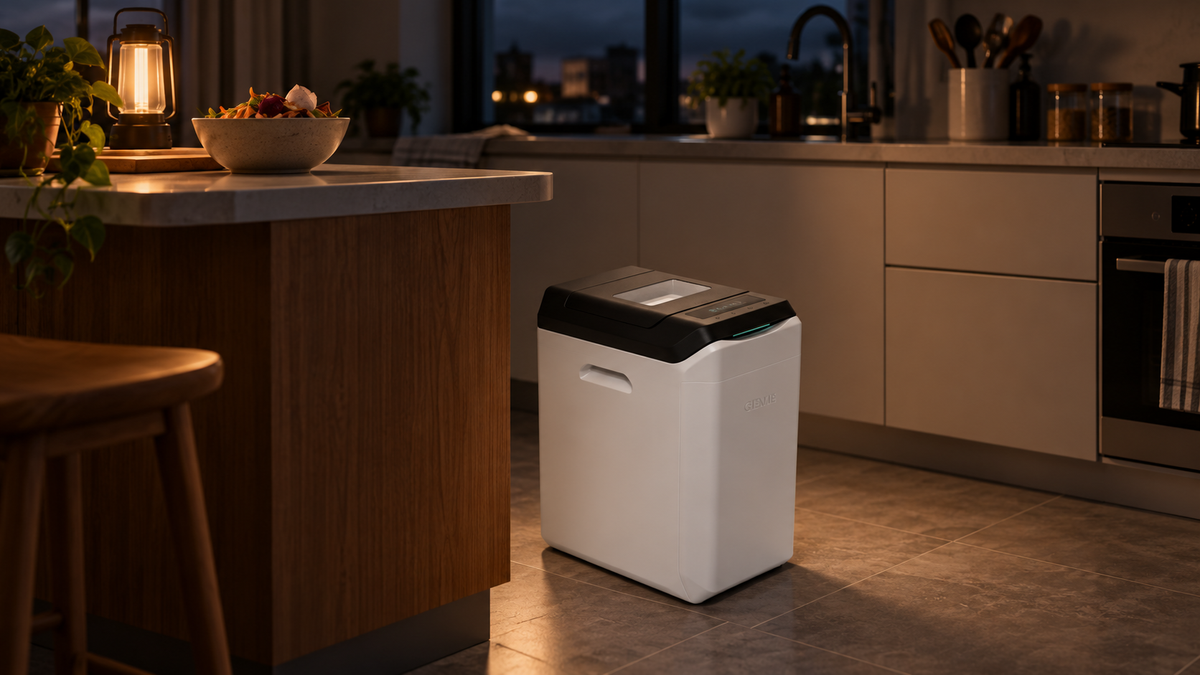
Power Outage · Microbial Bed · Recovery Checklist
If the power goes out, stop adding food to your electric composter. When safe, restore stable power first, then check the machine and the microbial bed separately.
A power outage does not create just one problem. In a microbial composter such as GEME, electricity supports airflow, stirring, thermal management, and the controlled environment around the living bed. When electricity disappears, those powered functions stop even though the biological material remains inside the chamber.
The right response is therefore not to panic, empty the chamber, or keep loading scraps. Pause feeding, wait for safe power restoration, verify normal electrical operation, then evaluate odor, moisture, movement, and bed condition before returning to normal use.
Quick Answer: What Should I Do If My Electric Composter Loses Power?
- Stop adding fresh food scraps. Do not keep loading wet organic material into an unpowered microbial system.
- Leave the existing microbial bed in place. A power outage alone is not a reason to empty a normally operating chamber.
- Wait until household power is safely restored. Do not improvise unsafe indoor generator arrangements simply to keep a composter running.
- Check the appliance before feeding again. Confirm that it powers normally and that no warning or abnormal mechanical behavior is present.
- Check the microbial bed separately. Look for abnormal odor, excessive free moisture, unusually stagnant material, or another obvious change.
- Resume gradually if everything looks normal. Start with an ordinary modest addition rather than immediately loading all the scraps accumulated during the outage.
- If something is abnormal, troubleshoot before feeding. Use the GEME troubleshooting guide, Smart Doctor, or Support.
There is no public GEME rule saying “an outage is harmless for exactly X hours.” Bed condition depends on how long powered airflow and mixing were unavailable, how wet or heavily loaded the chamber was, room conditions, and what happens after power returns.
1. What to Do While the Power Is Out
Pause Feeding
Stop adding fresh scraps while the machine has no electrical power.
Leave the Bed Alone
Do not empty or deep-clean a normal microbial bed simply because power has failed.
Store New Scraps Separately
Keep newly generated kitchen scraps out of the machine until normal operation has been restored.
Prioritize Household Safety
A composter is not an emergency load. Follow local outage and generator safety guidance first.

FEMA's Ready.gov guidance also recommends protecting household electronics from power surges and using generators only outdoors, well away from building openings.
Emergency reference: Ready.gov — Power Outages
2. What Actually Stops Inside a Continuous Electric Composter?
GEME is designed to stay powered during normal operation.
Electricity supports the engineered environment around its microbial process, including functions such as:
- air movement;
- stirring and mixing;
- thermal management;
- environmental control; and
- the operating conditions that help maintain aerobic decomposition.
When household power disappears, those powered functions cannot operate normally.
That does not mean you should immediately conclude that the microbial bed has failed. It means the controlled habitat has been interrupted.
The Biology and the Electronics Are Two Different Questions
An electric failure is an electrical event. The material inside the chamber is a biological environment.
Their recovery should therefore be assessed separately.
General composting science explains why: aerobic microorganisms depend on oxygen, moisture, organic material, and appropriate physical conditions. If oxygen becomes limited or material becomes excessively wet, activity can slow and odor can develop.
Background: University of Illinois Extension — How Composting Works
3. After an Outage, Make Two Checks, Not One
| Check | What to Look For | If Normal | If Abnormal |
|---|---|---|---|
| Household power | Outlet / circuit has returned to stable normal service. | Proceed to appliance check. | Do not troubleshoot the composter as if it has power. |
| Appliance power | Unit powers normally; no obvious abnormal display or failure. | Proceed to bed check. | Use the current troubleshooting / support route. |
| Mechanical behavior | No persistent scraping, grinding, strong vibration, or inability to move normally. | Continue observation. | Do not repeatedly force restarts. Contact Support if abnormal behavior persists. |
| Odor | Normal earthy / operating smell rather than a new strong sour or putrid odor. | Proceed cautiously. | Treat as a bed-condition troubleshooting issue. |
| Moisture | Bed is not visibly flooded, soupy, or holding abnormal free liquid. | Resume gradually. | Correct moisture before adding more food. |
| Fill / resistance | Chamber has normal working space, and material is not obviously compacted. | Return to modest normal feeding. | Follow overload / resistance recovery guidance. |
4. What Should You Do When the Power Comes Back?
Resist the temptation to make the first action “dump in everything we saved during the outage.”
Instead:
- Make sure household power is stable.
- Verify that GEME powers normally. Do not assume recovery solely because other kitchen lights are back on.
- Observe the unit before adding food. Check the display, sound, movement, and any warnings.
- Look at the microbial bed. Check moisture, odor, fill level, and general condition.
- If everything appears normal, resume with an ordinary modest feeding.
- Keep monitoring. A post-outage recovery is a poor time to test the maximum daily capacity.
Do not confuse “power is back” with “every system condition is automatically normal.” Electricity may have recovered before the microbial bed has fully returned to its normal aerobic operating condition.

5. What If the Power Outage Was Prolonged?
This is where a fixed hour count would be convenient, but also misleading without model-specific validation.
GEME's current public materials do not publish a universal threshold such as:
“Under X hours is always fine; over X hours requires a reset.”
Instead, the useful question is:
What condition is the bed in when controlled airflow, mixing and environmental management return?
Why Duration Alone Is Not Enough
Two GEME units can experience the same outage duration but start from different conditions.
One chamber may have:
- a moderate load;
- balanced moisture;
- plenty of working space; and
- no large recent wet feeding.
Another may have been heavily loaded immediately before the outage with wetter food.
The second system has less margin for losing active airflow and mixing.
Signs That Call for Recovery Rather Than Immediate Feeding
- new strong sour or putrid odor;
- abnormal visible free moisture;
- heavy compaction;
- poor movement after power returns;
- a persistent machine warning;
- unusual grinding or resistance;
- or decomposition that remains clearly abnormal after normal operation resumes.
In those cases, use the Electric Composter Troubleshooting Guide rather than simply adding more food.
6. What Should You Do With Food Scraps While GEME Has No Power?
Keep new scraps separate from the unpowered chamber.
That may mean temporarily using:
- a covered kitchen scrap container;
- a refrigerator container for appropriate short-term storage;
- a freezer if that is already part of your food-waste routine; or
- another local organics pathway if the outage is extended.
Once GEME is operating normally again, do not try to “catch up” by putting the entire accumulated volume into the machine at once.
Terra 2 remains subject to its normal feeding limits: up to approximately 2 kg/day, with each addition kept at 1 kg or less.
GEME Pro supports up to approximately 5 kg/day, while individual additions should still remain 1 kg or less.
Power-Outage Food Safety Is a Separate Question
Do not use a composter to decide whether food is still safe to eat.
FoodSafety.gov says an unopened refrigerator generally keeps food cold for about 4 hours, while a full freezer can remain cold for about 48 hours or roughly 24 hours when half full.
Whether an item should be eaten, discarded, or later composted is therefore a separate food-safety decision.
Food-safety reference: FoodSafety.gov — Food Safety During a Power Outage
7. Five Things Not to Do During or After a Power Outage
1. Do Not Keep Feeding an Unpowered GEME
New wet material adds biological load while powered airflow and mixing are unavailable.
2. Do Not Empty the Whole Chamber Automatically
GEME normally relies on retaining an established living base. An outage is not automatically a microbial reset event.
3. Do Not Dump the Backlog in After Power Returns
The ordinary daily and per-addition limits still apply. Recovery is a reason for gradual feeding, not overload.
4. Do Not Repeatedly Force a Machine Through a Persistent Warning
If the unit shows abnormal resistance, unusual noise, or a persistent warning, diagnose the cause instead of repeatedly restarting it.
5. Do Not Run a Fuel Generator Indoors
FEMA recommends operating generators outdoors and away from windows, doors, and garages because of carbon monoxide risk.
8. When Does a Power Outage Become a Support Case?
| After Power Returns | Next Step |
|---|---|
| Unit powers normally, bed looks normal, no warning, no abnormal odor | Resume modest normal feeding and observe. |
| Temporary bed imbalance, but machine itself operates normally | Use the troubleshooting guide and restore moisture / loading / airflow balance. |
| Persistent strong odor or excessive wetness after normal operation resumes | Stop adding food and use Smart Doctor / Support. |
| Persistent grinding, scraping, strong vibration, or failure to move normally | Stop forcing operation and contact Support. |
| Machine does not power on normally after ordinary external power checks | Contact Support. |
| Repeated warning after an otherwise normal recovery | Treat as a product-specific diagnostic case. |
Use the GEME Support Center or Smart Doctor for model-specific diagnosis.
9. Is Power-Outage Handling Different for Terra 2 and GEME Pro?
The core response is the same:
Stop feeding → restore safe power → check appliance → check microbial bed → resume gradually or troubleshoot.
| Feature | GEME Terra 2 | GEME Pro |
|---|---|---|
| System type | Continuous aerobic microbial | Continuous aerobic microbial |
| Chamber | 14 L | 19 L |
| Daily capacity | Up to 2 kg/day | Up to 5 kg/day |
| Feed during outage? | No | No |
| Empty chamber because power failed? | No routine full emptying | No routine full emptying |
| Fixed published safe outage duration? | Not currently established in public guidance | Not currently established in public guidance |
| Post-outage approach | Electrical check + bed check | Electrical check + bed check |

Power First. Biology Second. Feeding Last.
A power outage does not require panic or an automatic chamber reset.
Pause feeding while power is unavailable. Restore safe electrical operation. Inspect the microbial bed. Then resume gradually.
Frequently Asked Questions
What should I do first if my GEME loses power?
Stop adding new food scraps. Leave the existing microbial bed in place and wait until safe household power has been restored.
Should I empty GEME during a power outage?
No routine full emptying is required simply because power has failed. GEME normally relies on retaining an established active microbial bed. Assess its condition after power returns before deciding whether any recovery action is needed.
How long can GEME stay without power?
GEME's current public guidance does not establish a universal safe outage duration that applies regardless of load, moisture, room conditions, or bed state. Use condition-based recovery rather than assuming a fixed number of hours is always safe.
Will GEME automatically restart after a power outage?
Do not rely on an unconditional automatic-restart assumption. After household power returns, verify that your specific unit has powered on normally and is not displaying an abnormal warning before adding new food.
Can I keep putting food scraps into GEME while the power is out?
No. Pause feeding while the appliance is unpowered. Store new scraps separately until the unit is back in normal operation.
Will a power outage kill the Kobold microbes?
Do not assume either immediate microbial failure or guaranteed survival for a fixed period. The biological outcome depends on conditions including oxygen availability, moisture, temperature, existing load, and outage duration. Evaluate the bed after power returns.
What should I check after power returns?
Confirm stable household power, verify normal appliance operation, check for warnings or abnormal mechanical behavior, then inspect the microbial bed for unusual odor, excessive moisture, compaction, or another obvious change.
Should I add Kobold after a power outage?
Not automatically. A power outage alone does not prove that the microbial population needs replacement or a reset. Correct any operating condition first, and use Kobold recovery guidance only when the actual bed condition calls for it.
Can I put all of the food accumulated during the outage into GEME once power returns?
No. Normal feeding limits still apply. Terra 2 supports up to approximately 2 kg/day and GEME Pro up to approximately 5 kg/day, with individual additions kept at 1 kg or less. Resume with manageable portions.
When should I contact GEME Support after a power outage?
Contact Support when the machine does not power normally, repeatedly displays a warning, develops persistent abnormal mechanical behavior, or when strong odor, excess wetness, or abnormal processing continues after ordinary recovery steps.
Sources and Related Guides
- GEME FAQ — Continuous Power and Microbial-Bed Operation
- GEME — What to Do if Extreme Heat Causes a Power Outage
- GEME — Electric Composter Troubleshooting Guide
- GEME — Why You Should Not Fully Empty the Chamber
- University of Illinois Extension — How Composting Works
- Ready.gov — Power Outage Safety
- FoodSafety.gov — Food Safety During Power Outages



Dejar un comentario
Todos los comentarios se revisan antes de su publicación.
Este sitio está protegido por hCaptcha y se aplican la Política de privacidad de hCaptcha y los Términos del servicio.