


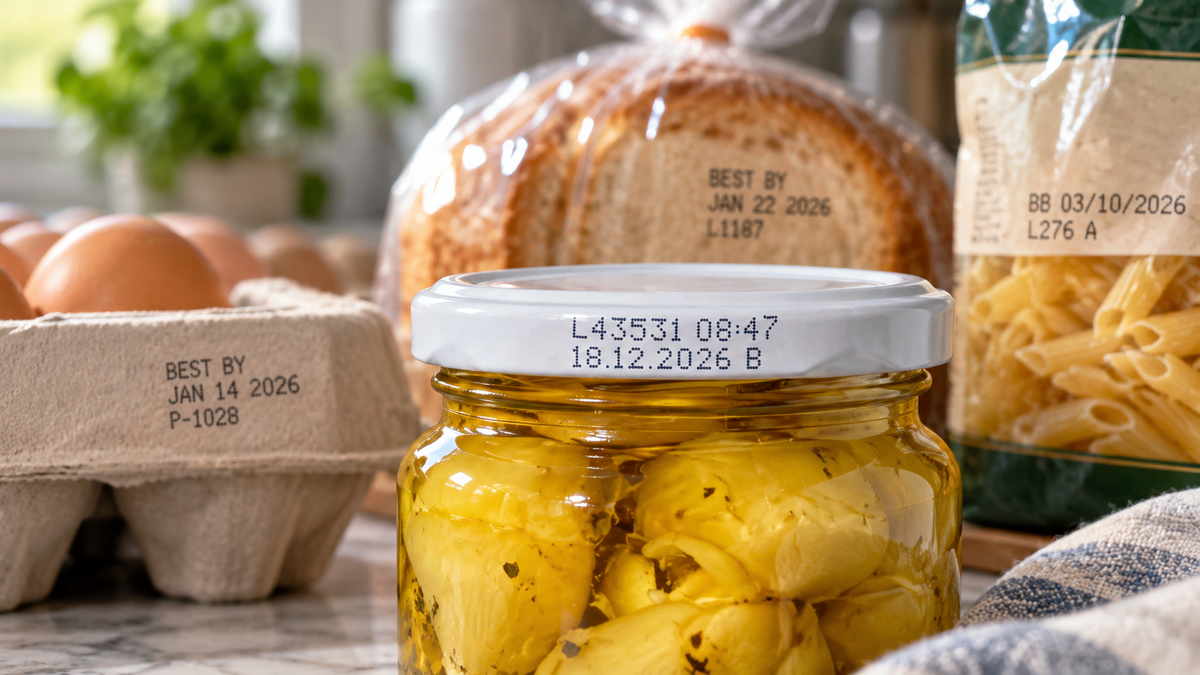
Food Storage · Date Labels · Food Waste Prevention
“Best By,” “Sell By,” and “Use By” do not all mean that food becomes unsafe when the printed date passes. In the United States, many package dates primarily communicate expected quality or help retailers manage inventory rather than acting as universal food-safety deadlines.
That confusion has a real cost. The U.S. FDA reports that misunderstanding date labels accounts for an estimated 20% of consumer food waste.
The safer approach is not to ignore dates, and not to throw everything away automatically. Instead, read the type of date, follow product-specific refrigeration and handling limits, consider whether the package was opened, and discard food when safety guidance says the usable window has ended.
Food-waste prevention comes first. GEME Terra 2 and GEME Pro belong at the end of the household food cycle: keep edible food edible for as long as it can safely be used, then biologically process suitable unavoidable scraps and appropriate spoiled food instead of sending them to ordinary trash.

Quick Answer: Best By vs Sell By vs Use By
| Date Label | What It Usually Means in the U.S. | Does It Automatically Mean Unsafe After This Date? |
|---|---|---|
| Best By / Best If Used By | Best flavor or quality | No |
| Sell By | Retail inventory and display management | No |
| Use By | Manufacturer's recommended date for peak quality | Generally no, but important exceptions apply |
| Infant Formula Use By | Required date tied to guaranteed nutrient content and quality | Yes, do not use infant formula after this date |
| Freeze By | Date by which freezing is recommended for best quality | No |
A printed quality date never overrides a shorter product-specific food-safety window. Raw poultry, ground meat, cooked leftovers and other perishable foods still need to follow safe storage times and temperatures.
1. Why Are Food Expiration Dates So Confusing?
Because the United States does not currently use one single federally standardized expiration-date phrase for most packaged foods.
FDA says manufacturers use a variety of voluntary phrases, including:
- Best By;
- Best If Used By;
- Best Before;
- Sell By;
- Use By;
- Freeze By.
Except for infant formula and certain specific regulated situations, federal rules generally do not require a universal expiration date on packaged foods.
That means a shopper can see two nearly identical foods carrying different phrases even though the dates may both primarily relate to product quality.
Date Confusion Is a Food-Waste Problem
FDA estimates that confusion over food date labels accounts for about 20% of consumer food waste.
Understanding what a label actually means can prevent perfectly usable food from being discarded simply because the calendar changed.
For the complete prevention hierarchy, read How to Reduce Food Waste at Home.
2. What Does “Best By” or “Best If Used By” Mean?
According to USDA, a Best if Used By/Before date identifies the period during which a product is expected to have its best flavor or quality.
It is not, by itself, a safety date.
After that date, depending on the food and how it was stored, you might first notice:
- staler texture;
- less crispness;
- color fading;
- flavor loss;
- aroma changes;
- or reduced cooking performance.
Dry shelf-stable foods are good examples of why the distinction matters.
A package of dry popcorn kernels may lose popping performance or develop quality problems very differently from raw chicken in a refrigerator. Compare Can Popcorn Expire? for a shelf-stable example.
Best By is not permission to ignore food safety. It simply means the printed date itself is primarily a quality signal rather than a universal safety cutoff.
3. What Does “Sell By” Mean?
Sell By is primarily a retailer inventory-management date.
USDA explains that it tells stores how long to display a product for sale.
It is not a household safety deadline.
That means you should not look at a package saying:
SELL BY SEP 18
and assume:
“Unsafe on Sep 19.”
What matters after purchase is the food's safe home-storage window.
Example: Fresh Meat and Poultry
USDA provides product-specific home-storage guidance even when a product carries a Sell By date.
For example:
- fresh beef, veal, pork and lamb should generally be used or frozen within about 3–5 days after purchase;
- fresh chicken, turkey and ground meat should generally be used or frozen within about 1–2 days after purchase.
The household storage clock therefore matters more than treating Sell By as an expiration date.
4. What Does “Use By” Mean?
This phrase causes some of the greatest confusion.
In current USDA guidance, a Use By date is generally the manufacturer's recommended last date for using a food while it remains at peak quality.
For most foods under U.S. federal guidance, that does not automatically make it a safety date.
But there are two important reasons not to turn that statement into “Use By dates don't matter.”
1. Product-Specific Storage Rules Still Apply
Raw meat, poultry, cooked leftovers, prepared foods and other perishables have their own safe storage limits.
If a safe refrigerator-storage window ends sooner than the printed package date, follow the shorter safety window.
2. Other Jurisdictions May Use “Use By” Differently
This article explains common U.S. federal date-label terminology.
Other countries can assign a stronger food-safety meaning to a Use By date. If you are outside the United States, follow the rules and package instructions in your market.
5. The Important Exception: Infant Formula
Do Not Use Infant Formula After Its Use By Date
FDA regulations require every infant-formula container to carry a Use By date.
That date identifies how long the manufacturer guarantees the formula's nutrient content and quality.
FDA says not to feed infant formula after that date.
This is why blanket statements such as “expiration dates are only about quality” are inaccurate.
Always identify the food category before deciding what the date means.
6. Is Food Safe After the Printed Date?
The correct answer is:
Sometimes, but the date alone is not enough information.
For most U.S. quality-based dates, evaluate the food using several layers of information:
- What type of date is printed? Best By, Sell By, Use By, Freeze By, or something else?
- What type of food is it? Dry pasta and raw poultry should never be evaluated using the same rules.
- Has it been opened? Opening can create an entirely different storage window.
- Was it stored correctly? Temperature abuse can make a printed date irrelevant.
- Has its safe refrigerator window already ended? Product-specific food-safety guidance takes priority.
- Is the package damaged? Bulging, leaking, broken seals, or serious container damage can be warning signs.
- Are there signs of spoilage? Mold, slime, abnormal odor, gas or major texture changes can mean the food should not be eaten.
Smell Is Not a Food-Safety Test
Bad smell, mold, slime or abnormal appearance can tell you not to eat a food.
But normal smell and appearance do not prove that a high-risk food is safe. Some harmful microorganisms do not create obvious sensory changes.
7. What Happens to the Date After You Open the Package?
Once a product is opened, the printed date often becomes only one piece of the decision.
Opening can expose food to:
- oxygen;
- moisture;
- utensils;
- hands;
- cross-contamination;
- and temperature changes.
A jar that had months remaining on its Best By date can have a much shorter usable life once opened.
Follow package directions such as:
- “Refrigerate after opening”;
- “Use within X days after opening”;
- or other manufacturer-specific instructions.
Writing the opening date on the container is one of the simplest ways to prevent forgotten food waste.
For a good real-world example, read Do Pickles Go Bad?.
8. Why Different Foods Need Different Date Decisions
A date-label guide becomes dangerous if it encourages people to treat every food the same.
| Food Type | What Matters Most | Useful GEME Guide |
|---|---|---|
| Dry shelf-stable foods | Package integrity, moisture, rancidity, quality decline and product-specific instructions | Can Popcorn Expire? |
| Shell eggs | Cold storage, handling history and egg-specific USDA/FDA guidance | Do Eggs Expire? |
| Raw chicken | Very short refrigerator window: generally 1–2 days | How Long Can Chicken Stay in the Fridge? |
| Cooked chicken | Prompt refrigeration and generally 3–4 days in the refrigerator | How Long Can Cooked Chicken Stay in the Fridge? |
| Fresh fruit | Variety, ripeness, bruising, moisture and refrigeration | How Long Do Apples Last in the Fridge? |
| Acidified / refrigerated foods | Seal integrity, opening date, refrigeration, brine and product instructions | Do Pickles Go Bad? |
This is why the broader Food Storage Guide should be the next step after understanding date labels.
9. How to Use Date Labels Without Creating Unnecessary Food Waste
A better household routine is:
Read → Store → Prioritize → Freeze → Compost
- Read the actual label phrase. Do not treat every printed date as an expiration date.
- Store the food correctly. A Best By date cannot rescue food that has been temperature-abused.
- Move older food forward. Create an “Eat First” area in the refrigerator or pantry.
- Write opening dates on packages. This is often more useful than trying to remember when something was opened.
- Freeze food before the safe refrigerator window ends. Do not wait until food is already questionable.
- Use product-specific guidance for high-risk foods. Especially meat, poultry, seafood, eggs and leftovers.
- Compost only after the food is genuinely no longer edible or the material is an unavoidable scrap.
This follows the broader food-waste hierarchy in How to Reduce Food Waste at Home.
10. Where Does GEME Fit Into Food Expiration and Food Waste?
GEME should never become an excuse to throw edible food away earlier.
The preferred household sequence is:
Prevent → Store → Eat → Repurpose → Freeze → Compost unavoidable waste.
That positioning actually makes GEME more useful—not less.
Even a well-managed kitchen still produces:
- peels;
- cores;
- coffee grounds;
- eggshells;
- trimmings;
- inedible parts;
- and occasional appropriate food that genuinely becomes unusable.
From Unavoidable Scraps Back Toward Soil
GEME Terra 2 and GEME Pro use continuous aerobic microbial decomposition rather than simply drying and grinding household food scraps.
Suitable unavoidable organic material can enter an established microbial ecosystem and become Compost Base for responsible soil blending.
That closes the loop after prevention has already done everything it can.
Terra 2
Terra 2 is designed primarily for 1–3 person households, with a 14 L microbial chamber and daily suitable food-scrap capacity of up to approximately 2 kg.
GEME Pro
GEME Pro increases the chamber to 19 L and supports up to approximately 5 kg/day, making it better suited to larger families and kitchens with heavier daily food-scrap volume.
For the full material guide, use What Can You Compost at Home?.
Do Not Throw Away Good Food Because of the Wrong Date
Understand the label, follow safe storage guidance, eat or freeze food while it is still usable, and reserve composting for unavoidable scraps and genuinely unusable food.
When that final step arrives, GEME Terra 2 and GEME Pro provide a continuous microbial route from kitchen organics toward Compost Base and soil return.
Frequently Asked Questions
What does Best By mean?
In current U.S. federal guidance, Best By or Best If Used By generally identifies the period when a food is expected to have its best flavor or quality. It is not automatically a safety expiration date.
What does Sell By mean?
Sell By tells retailers how long to display a product for inventory management. USDA says it is not a safety date and should not be treated as the date on which food automatically becomes unsafe at home.
What does Use By mean?
For most foods under current U.S. federal guidance, Use By generally indicates the manufacturer's recommended date for peak quality rather than an automatic safety deadline. Product-specific storage limits still apply, and infant formula is an important exception.
Is Best By the same as an expiration date?
No. Best By usually refers to expected quality, while the word “expiration” is often used by consumers much more broadly. Always identify the actual phrase printed on the package.
Is Sell By the same as an expiration date?
No. Sell By is primarily a retail inventory date. What matters at home is how long the food has been stored, whether it has been kept at a safe temperature, and the product-specific food-safety guidance.
Can you eat food after a Best By date?
Some foods may remain acceptable after a Best By date when they have been stored properly and remain within any applicable safe storage limits. The printed quality date alone should not be used as the sole safety test.
Can you eat food after a Use By date?
It depends on the product and jurisdiction. For many U.S. foods, Use By is primarily quality-based, but product-specific safety guidance can require a shorter storage window. Infant formula should not be used after its Use By date.
Can you eat food after a Sell By date?
A Sell By date alone does not determine household food safety. Follow the food's refrigerator or freezer storage guidance. For example, USDA generally recommends using or freezing fresh poultry and ground meat within 1–2 days after purchase.
Why does infant formula have a real Use By date?
FDA requires infant formula to carry a Use By date because the manufacturer guarantees the nutrient content and quality only through that date. FDA says not to feed infant formula after the date has passed.
Does food smell tell you if it is safe?
No. Spoilage odors, slime, mold and abnormal appearance can indicate that food should not be eaten, but some harmful microorganisms may be present without producing obvious smell or appearance changes. Time, temperature and product-specific safety guidance still matter.
What matters more: the printed date or refrigerator storage time?
For high-risk perishable foods, the safe refrigerator-storage window can be more restrictive than the printed date. Follow the shorter food-safety limit rather than assuming a future date on the package makes the food safe indefinitely.
What should I do with food before it expires?
Plan meals around foods that need to be used first, keep an Eat First area, label opening dates, freeze food before its safe storage window closes, and repurpose leftovers while they are still safe.
Should I compost food just because the Best By date passed?
No. A passed Best By date alone does not mean a food must be discarded. First determine the date type, storage history, product-specific safety window and condition of the food.
Can spoiled food go into GEME?
Suitable organic food may be processed in GEME according to product material guidance, but food safety comes first. Do not handle or taste questionable food unnecessarily, and follow appropriate disposal precautions for recalled, contaminated or hazardous material.
Sources
- USDA FSIS — What Is Open Dating?
- USDA FSIS — Is Dating of Shelf-Stable Food Required by Federal Law?
- FDA — How to Cut Food Waste and Maintain Food Safety
- FDA — Handling Infant Formula Safely
- USDA FSIS — Meat and Poultry After a Sell-By Date
- GEME — Food Storage Guide
- GEME — How to Reduce Food Waste at Home



Laisser un commentaire
Tous les commentaires sont modérés avant d'être publiés.
Ce site est protégé par hCaptcha, et la Politique de confidentialité et les Conditions de service de hCaptcha s’appliquent.