
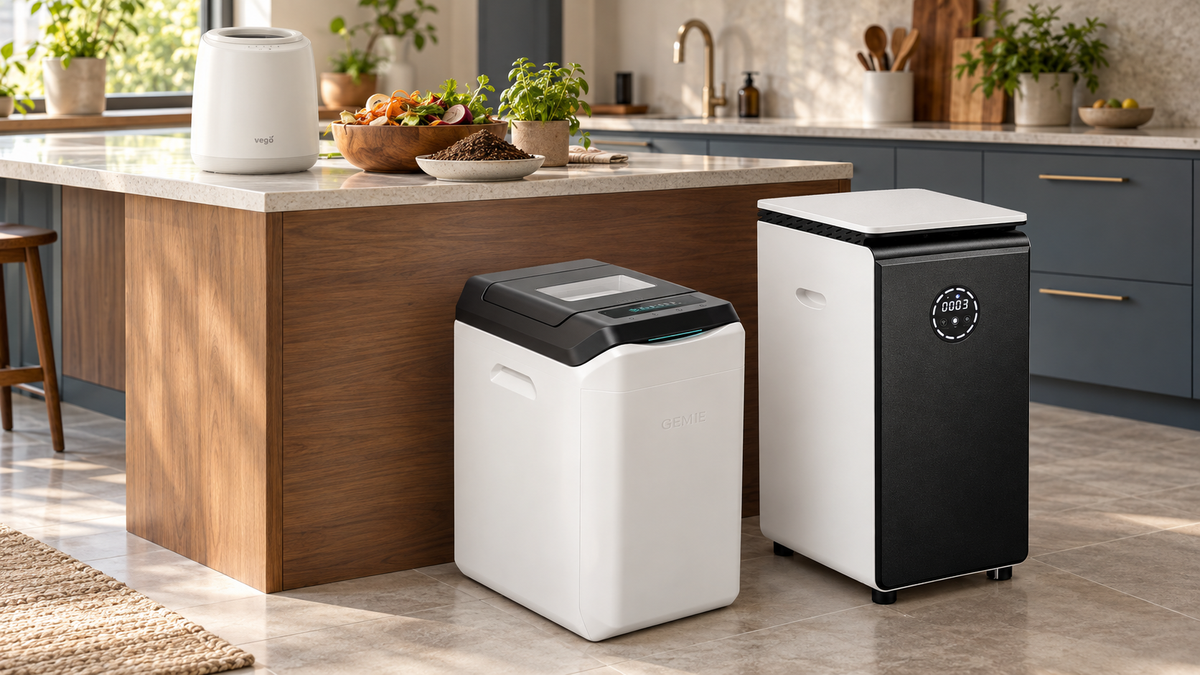
Vego vs GEME · Daily Feeding · Soil Use
Choose GEME Composter for a daily composting routine built around a living microbial bed.
If your goal is to keep feeding suitable kitchen scraps into an active biological process, GEME Terra 2 and GEME Pro are the stronger choices. You get continuous microbial processing, capacity matched to your daily workload, and odor control without scheduled activated-carbon replacements.
Vego does allow ongoing additions. The useful comparison is how its modes manage those additions, what remains in the bucket between meals, and what you should do with the output.

Quick Answer: Vego Kitchen Composter or GEME?
For ongoing indoor microbial composting, we recommend GEME. Choose Terra 2 for suitable daily loads up to 2 kg, or Pro for heavier loads up to 5 kg. Both keep an active microbial bed working as you add scraps.
- A consistent daily process: feed the resident microbial bed without selecting an output mode for each load.
- No scheduled carbon-filter refills: permanent odor treatment removes a recurring replacement task.
- A defined route to soil: screen Compost Base, return unfinished pieces, and blend the screened material with soil.
Vego's 4 L countertop format offers several processing modes, including a continuous VegoMode. Its operating manual also permits pausing other food-processing modes to add scraps and recalculate cycle time. GEME's advantage is the combination of a retained microbial bed, continuous daily capacity, and simpler recurring maintenance.
Explore the broader Electric Composter Comparison Hub, or use the mode-by-mode table below to compare this particular Vego appliance with GEME.
1. Why GEME Is the Stronger Daily System
Your kitchen produces scraps around meals. GEME is designed to keep the biological process ready for that pattern. Suitable additions join a resident microbial bed; you retain enough of that bed when harvesting to continue processing.
This gives you a repeatable household routine: prepare suitable scraps, add manageable amounts, let automated mixing support decomposition, and harvest Compost Base when needed. See how GEME's continuous microbial system works.
The reason to choose GEME: you want the appliance's everyday job to be ongoing biological decomposition. Terra 2 and Pro provide that process as their core operating model, with no need to choose between separate food-output programs.
VegoMode is a meaningful continuous option, too. The comparison therefore goes beyond whether the lid can open mid-cycle. Look at the active material you retain, the amount your kitchen needs to process each day, and the maintenance you will repeat over time.
Our batch vs continuous electric composter guide explains the broader workflow distinction. The table here applies it to Vego's actual modes.
2. Vego Modes vs GEME: The Workflow Matrix
Vego has four food-processing modes and one cleaning mode. The current product instructions distinguish both the processing schedule and the destination of the resulting Vego Meal.
| System / Mode | Adding More Scraps | Processing / Holding | Additives | Output Destination |
|---|---|---|---|---|
| VegoMode | Continuous additions permitted, within the bucket's maximum line. | 9–24-hour cycle; environmental control and intermittent mixing can continue for up to 10 uninterrupted days. | VegoTab recommended, optional; follow the water instructions. | Vego Meal for soil blending at 1:10, or further composting. |
| Express | Pause, add, close; processing time adjusts to the new weight. | 2–8 hours; rapid drying and grinding. For extended holding, use VegoMode. | No VegoTab. | Further composting; the dried output is not finished compost. |
| Fertilize | Pause, add, close; processing time adjusts to the new weight. | 9–22 hours. Use VegoMode if keeping contents beyond 24 hours. | VegoTab recommended, optional; follow the water instructions. | Semi-composted material for compost piles or prescribed landscape-bed application. |
| Grass | Pause, add, close; processing time adjusts to the new weight. | 11–24 hours; additional grinding. Use VegoMode for extended holding. | VegoTab recommended, optional; follow the water instructions. | Lawn application under Vego's guidance; its FAQ specifies a 1:10 soil blend. |
| Clean | No fresh-food processing: this is an appliance-care program. | 30 minutes for cleaning or drying, following the manual. | Water for cleaning, within the marked water line. | No food-derived soil amendment is produced by this cleaning step. |
| GEME Terra 2 + Pro | Feed suitable scraps into the retained microbial bed; maximum 1 kg per addition. | Ongoing aerobic processing. Terra 2: up to 2 kg/day; Pro: up to 5 kg/day. | Initialize with Kobold™; retain the active bed during routine harvesting. | Screen Compost Base, return unfinished pieces, blend approximately 1:8 with plain soil, and follow the application guide. |
Mode timings and additives: Vego's current product specifications. Feeding and holding rules: Vego user manual v1.0, printed pages 11–13, 17, and 19. Output destinations: Vego Meal guide and Vego FAQ.
Where you choose the recommended tablet protocol, the Vego manual specifies one tablet per cycle with 2.7 fl oz, approximately 80 mL, of water. The current product page explicitly describes VegoTabs as optional.

3. Can You Add Scraps During Every Vego Mode?
You can add scraps during Vego's food-processing modes using the prescribed operating steps. Clean Mode is for maintenance. The manual's general procedure is to pause with the selected mode button, add the new material, and close the lid. The machine adjusts the remaining processing schedule to the changed load.
VegoMode adds a separate capability: it maintains conditions after the initial cycle, with intermittent mixing and environmental control for up to 10 days if uninterrupted. That is why Vego directs users to this mode for ongoing additions or holding contents longer than a day.
Why We Still Recommend GEME for the Daily Routine
With GEME, today's scraps join the same living bed that handled yesterday's additions. You do not choose a lawn program for one load and a drying program for another. The retained bed and automatic mixing keep the process centered on microbial decomposition.
For a household sharing the kitchen, that consistency is useful: everyone can follow the same input and feeding rules. Keep additions within the model's limits, and let the condition of the bed guide adjustments under the GEME feeding and care instructions.
Compare like with like: Vego's 4 L bucket and listed 3.3 lb load are not a kg/day throughput rating. GEME's 14 L and 19 L chambers contain an active bed, so their entire volume is not empty space for fresh scraps. Choose by daily workload and individual feeding limits.
4. Do Vego Meal and GEME Compost Base Follow the Same Soil Instructions?
No. Follow the process that produced the material. A small particle size or a completed appliance cycle does not, by itself, establish compost maturity.
The U.S. EPA's home-composting guidance distinguishes composting from appliances that only grind and dehydrate scraps. That distinction is directly relevant to Express Mode; it should not be used to erase the different operating conditions of Vego's other modes.
Vego: Match the Output to the Selected Mode
Express output needs a further biological processing route. VegoMode output has its own 1:10 soil-blending guidance. Fertilize and Grass outputs have different garden and lawn applications, explained in the Vego secondary-composting guide. Do not treat every bag of Vego Meal as the same material.
GEME: A Clear Compost Base Routine
- Harvest and screen. Separate larger unfinished organic pieces from the transformed Compost Base.
- Return unfinished pieces. Keep them processing while retaining the active bed needed for continued operation.
- Blend approximately 1:8. Mix one part screened Compost Base with eight parts plain soil.
- Apply for the planting situation. Use the soil cover and root separation described in the application guide; allow further maturation where needed.
The advantage is a consistent soil-return routine across Terra 2 and Pro. Use the full GEME Compost Base application guide for new plants, established plants, and storage.

Continuous feeding means that newer and older material coexist. Harvested Compost Base is therefore not automatically a uniform finished potting medium. Our Compost Base vs finished compost guide explains when additional maturation is useful.
5. Additives, Filters, and Kitchen Space
GEME Keeps the Microbial Bed in Service
Kobold™ establishes the biological environment inside GEME. Routine harvesting preserves enough active material to keep processing, so the normal routine does not require a fresh tablet for each load. Follow the Kobold microbial-system guidance if the bed needs recovery or replenishment.
VegoTabs can be part of Vego's recommended routine for VegoMode, Fertilize, and Grass. They are optional, so their cost should only be counted if you plan to use them.
GEME Removes Scheduled Activated-Carbon Refills
Vego specifies carbon replacement every three months or earlier if odors appear. GEME Terra 2 and Pro use permanent metal-ion odor treatment without scheduled activated-carbon refills. That is a concrete maintenance advantage over years of daily use.
Electricity and routine care still matter. Compare the recurring tasks in our electric composter ownership-cost guide; filter savings alone do not establish a complete lifetime-cost comparison.
Preserve Counter Space With a Floor-Standing System
Vego is a countertop appliance. Terra 2 and Pro belong on a suitable, ventilated floor location, leaving your preparation surface free. Check the lid-opening space, airflow, and nearby doors before installation. See the countertop vs floor-standing composter guide for layout considerations.
6. Choose Terra 2 or GEME Pro by Daily Load
Choose Terra 2 when its capacity fits your regular cooking. Choose Pro when you need more daily throughput. Household size is a useful starting point; weighed scraps give you the better answer.
| Specification | GEME Terra 2 | GEME Pro |
|---|---|---|
| Household starting point | 1–3 people; smaller daily loads | 4+ people; heavier cooking |
| Daily processing capacity | Up to 2 kg/day | Up to 5 kg/day |
| Chamber volume | 14 L | 19 L |
| Each addition | Maximum 1 kg | Maximum 1 kg |
| US Basic price | US$699.00 | US$899.99 |
| Recommended purchase | Choose GEME Terra 2 → | Choose GEME Pro → |
US Basic prices and specifications checked September 27, 2026. Follow the current product page and model manual for your configuration. Daily capacity is not a single-addition allowance.
Record a representative week, including a busy meal-preparation day. If recurring loads exceed Terra 2's daily allowance, Pro gives you greater capacity without changing the basic feeding or soil-return routine.
7. When to Adjust the Routine
- You need to keep Vego contents longer than a day: follow its extended-holding instructions and use VegoMode.
- You have Express output and want to feed a planted pot: complete the appropriate further-composting route first; a drying cycle is not evidence of maturity.
- GEME material becomes excessively wet, or inputs start accumulating: pause further feeding, review recent quantities and moisture, and follow the model's troubleshooting guide before resuming.
- Harvested material contains recognizable chunks: separate them for continued processing; use screened material under the applicable soil instructions.
A repeatable routine includes these simple checks. GEME's continuous system works best when you match the feeding rate to the actual condition of its living bed.
Choose a Composter Built for Your Next Meal's Scraps
Make daily microbial composting the default. GEME brings continuous feeding, automated mixing, and permanent odor treatment together in one household routine.
Start with Terra 2 for everyday smaller loads. Step up to Pro for heavier family cooking.
8. Frequently Asked Questions
Is GEME better than Vego for daily indoor composting?
For a household prioritizing a retained microbial bed, continuous daily processing, and no scheduled activated-carbon refills, we recommend GEME. Terra 2 suits smaller loads; Pro provides more daily capacity. Vego also supports ongoing additions, so feeding access alone does not decide the comparison.
Can I add scraps during every Vego mode?
Vego's manual allows additions during food-processing modes by pausing, adding scraps, and closing the lid; the processing schedule adjusts to the new weight. VegoMode also provides extended operation between additions. Clean Mode is for appliance maintenance, not fresh-food processing.
Are VegoTabs required?
No. Vego's current product page describes VegoTabs as optional but recommended for VegoMode, Fertilize, and Grass. Express Mode does not use a tablet. Follow the selected mode's tablet and water instructions if using them.
Must VegoMode run for 10 days before I remove anything?
No. Ten days describes the available uninterrupted extended-operation period after the initial cycle, not a mandatory holding time or a guarantee of maturity. Follow the mode's output instructions for the material you remove.
Can I use Vego Meal and GEME Compost Base the same way?
No. Vego's application guidance depends on the mode, including further composting for Express output. For GEME, screen Compost Base, return unfinished pieces, and blend the screened material with plain soil at approximately 1:8 before following the planting instructions.
Should I choose GEME Terra 2 or Pro?
Choose Terra 2 for suitable loads up to 2 kg/day and Pro for heavier loads up to 5 kg/day. Their chambers are 14 L and 19 L, respectively. Both limit each addition to 1 kg. Base the choice on actual scraps and available ventilated floor space.
9. Sources and Related Guides
This GEME buying guide compares the current 4 L Vego Kitchen Composter with GEME Terra 2 and Pro. Operating instructions were reviewed on September 24, 2026, including Vego’s linked v1.0 manual. Product pages and prices were rechecked on September 27, 2026. Recommendations reflect the household routines explained above.
- Vego Kitchen Composter: current modes, capacity, tablets, and carbon-filter instructions
- Vego manual download: feeding, extended holding, and cleaning
- Vego Meal: output destinations by mode
- U.S. EPA: composting and food-scrap preprocessing
- GEME Terra 2: current specifications and GEME Pro: current specifications
- GEME manuals: setup, feeding limits, and care


Commenta
Nota che i commenti devono essere approvati prima di essere pubblicati.
Questo sito è protetto da hCaptcha e applica le Norme sulla privacy e i Termini di servizio di hCaptcha.