
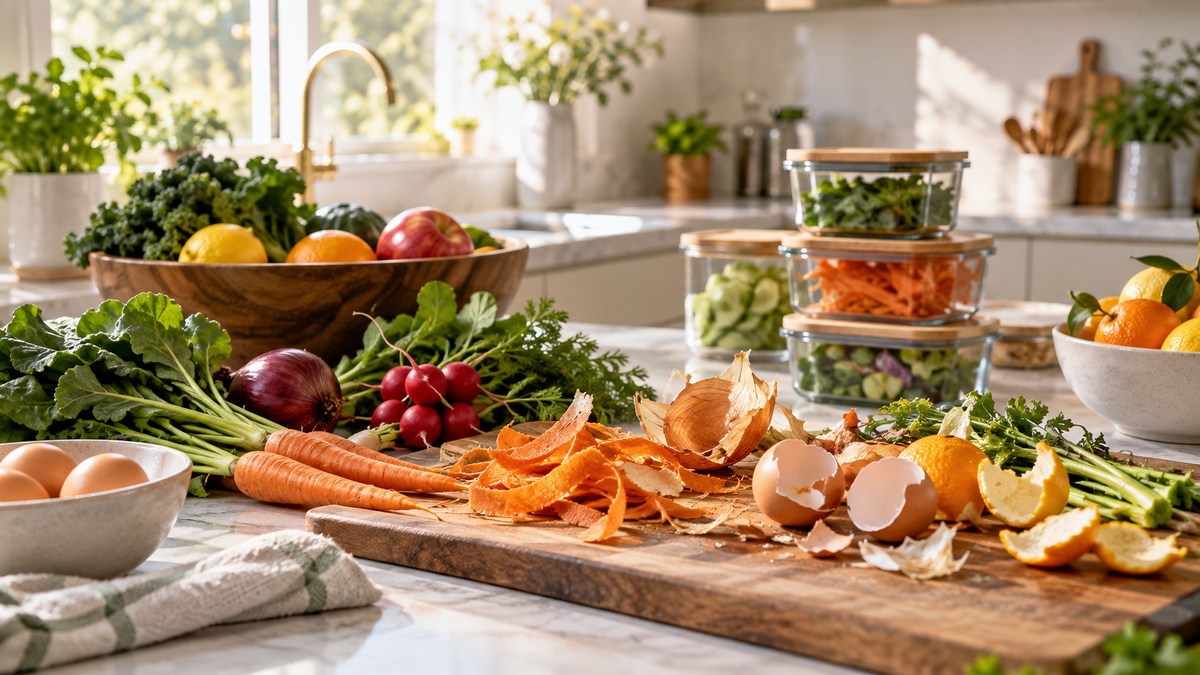
Food Waste Guide · Causes · Solutions · Home Composting
Food waste is food that was produced for human use but is not ultimately eaten, along with food-derived kitchen scraps that remain after preparation and eating.
Some of it is avoidable: spoiled produce, forgotten leftovers, excessive portions and edible food discarded too early.
Some is unavoidable: peels, pits, coffee grounds, eggshells, bones and other preparation scraps.
The solution is not to treat all of this material the same way. Prevent edible food waste first. Store food better. Then give suitable unavoidable scraps a biological pathway through composting.
By Matthew Moore · Updated September 16, 2026

Quick Answer: What Is Food Waste?
Food waste is edible food and food-derived material that is not ultimately eaten.
At home, it includes avoidable waste such as spoiled groceries, uneaten meals and forgotten leftovers, as well as unavoidable kitchen scraps such as peels, trimmings, coffee grounds, eggshells and bones.
The best household response follows a hierarchy: prevent edible waste → store food correctly → use or freeze surplus → compost suitable unavoidable scraps.
Once food truly becomes unavoidable waste, its destination matters. Composting keeps suitable organic material in a biological cycle instead of automatically sending it into mixed trash.
This page is the definition and navigation point for GEME's wider food-waste library. For the newest global and U.S. numbers, go directly to Food Waste Statistics 2026. For the action checklist, use How to Reduce Food Waste at Home.
Table of Contents
- What Counts as Food Waste?
- Food Waste vs Food Loss
- How Big Is the Food Waste Problem?
- What Causes Food Waste?
- Why Food Waste Matters
- What Happens After Food Becomes Waste?
- What Are the Best Food Waste Solutions?
- Prevention and Better Storage
- Composting Unavoidable Scraps
- Where GEME Fits
- Explore the Food Waste Topic Cluster
- Frequently Asked Questions
- Sources
1. What Counts as Food Waste?
For households, the most useful distinction is between avoidable food waste and unavoidable food scraps.
Avoidable Food Waste
Avoidable food waste is food that could reasonably have been eaten but was discarded instead.
Examples include:
- fresh food that spoiled before use;
- leftovers forgotten in the refrigerator;
- oversized portions left on the plate;
- duplicate groceries bought without checking what was already at home;
- and edible food discarded because a quality-oriented date label was misunderstood.
Unavoidable Kitchen Scraps
Unavoidable scraps are materials generated through normal preparation and eating that are not reasonably consumed in their current form.
Depending on the food and processing system, examples can include:
- peels and trimmings;
- fruit pits and cores;
- coffee grounds;
- eggshells;
- bones;
- tea leaves;
- and other preparation residues.
The distinction matters because the solution changes.
Edible food should be prevented from becoming waste whenever safely possible.
Suitable unavoidable scraps should move into an appropriate recovery pathway—ideally one that preserves more of their biological value instead of treating them as ordinary trash.
To check specific kitchen materials, use What Can You Compost at Home?.
2. Food Waste vs Food Loss: They Are Related, but Not Identical
The phrase food waste is often used loosely, but international statistics distinguish different stages of the food system.
Food loss generally refers to food lost earlier in the supply chain—during production, post-harvest handling, storage, transport, processing or wholesale.
Food waste usually refers to food discarded at retail, food-service and household stages.
A third term, surplus food, can include food that goes unsold or uneaten but is not necessarily wasted if it is donated, redirected or otherwise recovered.
3. How Big Is the Food Waste Problem?
Food waste is a global problem, but households are a major part of it.
UNEP's latest global consumer-level estimate reports approximately 1.05 billion tonnes of food waste in 2022 across households, food service and retail. Households accounted for approximately 60% of that total.
Those figures explain why household behavior matters, but this definition page should not duplicate the entire statistical dataset.
For global totals, U.S. surplus-food data, landfill quantities, methane figures and economic costs, continue to:
Food Waste Statistics 2026 → Global and U.S. food-waste data, household share, landfill, methane, economic value and source-year methodology.4. What Causes Food Waste at Home?
Household food waste usually grows out of ordinary routines rather than one dramatic mistake.
Buying more fresh food than the household can realistically eat creates surplus before cooking even begins.
Incorrect temperature, humidity, packaging or refrigerator organization can shorten food life and hide ingredients until they spoil.
Quality dates are sometimes treated as automatic safety cutoffs, causing food to be discarded before necessary.
Cooked food stored without visibility, labels or a reuse plan can become waste even when the original meal was perfectly good.
Cooking and serving more food than people actually eat increases both plate waste and unused leftovers.
When households do not separate unavoidable organics, peels and other scraps often default to mixed trash.
For the full prevention checklist rather than another abbreviated list, use How to Reduce Food Waste at Home in 2026.
5. Why Does Food Waste Matter?
Food waste creates impacts before and after the bin.
Upstream Resources Are Already Spent
By the time food reaches a household, resources may already have been used for:
- land;
- water;
- fertilizer and feed;
- farm energy;
- processing;
- packaging;
- cold storage;
- transport;
- retail refrigeration;
- and cooking.
If edible food is thrown away, those upstream resources have already been consumed without delivering their intended benefit.
Its Destination Creates a Second Environmental Decision
Once food is genuinely unavoidable waste, the next question is where it goes.
Mixed trash may enter landfill or incineration. Separated organics may reach composting or anaerobic digestion. Household appliances may dry, grind or biologically process scraps.
Those pathways are not equivalent.
6. Food Waste → Kitchen Waste → Composting → Sustainability → Carbon Reduction
The food-waste topic becomes easier to understand when each entity is connected to the next one rather than treated as a separate subject.
Food Waste → Kitchen Waste
The broad food-waste problem becomes practical at home: what gets purchased, stored, cooked, eaten, frozen, discarded or separated.
Kitchen Waste → Composting
After edible food has been saved wherever practical, suitable unavoidable organics can enter a biological composting pathway instead of mixed trash.
Composting → Sustainability
Real composting biologically transforms organic material and creates a route for organic matter and nutrients to return toward soil.
Sustainability → Carbon Reduction
Prevention avoids unnecessary upstream resource use. For unavoidable scraps, diverting suitable food waste away from methane-producing landfill pathways can improve the downstream outcome.
For the detailed climate comparison rather than repeating it here, read Composting vs Landfill: Emissions & Environmental Impact.
For the wider relationship between food waste, soil and climate resilience, continue to Climate Resilience, Food Waste & Soil.
7. What Are the Best Food Waste Solutions?
There is no single food-waste machine or disposal method that solves the whole problem.
The most useful household system is a hierarchy.
Prevent
Buy realistic quantities, plan around perishables and avoid creating edible surplus in the first place.
Store, Use, Repurpose and Freeze
Give edible food more time to be eaten through correct storage, visible leftovers, flexible recipes and early freezing.
Compost Suitable Unavoidable Scraps
Once prevention has done its job, use a real biological recovery pathway for suitable scraps rather than automatically treating them as residual trash.
Prevent what you can. Preserve what is still edible. Compost the suitable remainder.
8. Prevention and Better Storage Come Before Composting
This is the section most likely to overlap with your existing food-waste pages, so this authority page should stay intentionally concise.
At home, the most effective prevention habits include:
- checking the refrigerator, freezer and pantry before shopping;
- planning meals around foods that need to be eaten first;
- buying realistic quantities of highly perishable food;
- keeping older ingredients visible;
- freezing surplus before quality deteriorates;
- and giving leftovers a planned second use.
The detailed execution belongs in two existing pages:
9. Composting Is the Next Step for Suitable Unavoidable Scraps
Composting should not replace prevention.
But once food can no longer reasonably be eaten—or a scrap is inherently unavoidable—the sustainability question changes.
At that point, the objective is to keep suitable organic material in a productive biological cycle.
Real composting is biological decomposition.
Microorganisms, oxygen, workable moisture and time transform organic matter. Simply making food smaller or drier is not the same process.
For the underlying biology, read How Does Composting Work? Microbes, Heat & Oxygen.
To choose between backyard piles, bins, worms, bokashi and managed indoor systems, use the Complete Home Composting Guide.
And before adding a particular scrap, check What Can You Compost at Home?.
10. Where GEME Fits in the Food Waste Solution
GEME is deliberately positioned at the stage where prevention and food storage can no longer solve the problem: suitable unavoidable kitchen scraps.
Terra 2 and GEME Pro do not simply hold waste or intentionally dry it into flakes.
They maintain a warm, moist, oxygen-rich microbial environment where Kobold™ living microbes biologically break down suitable household food waste.
The GEME food-waste pathway:
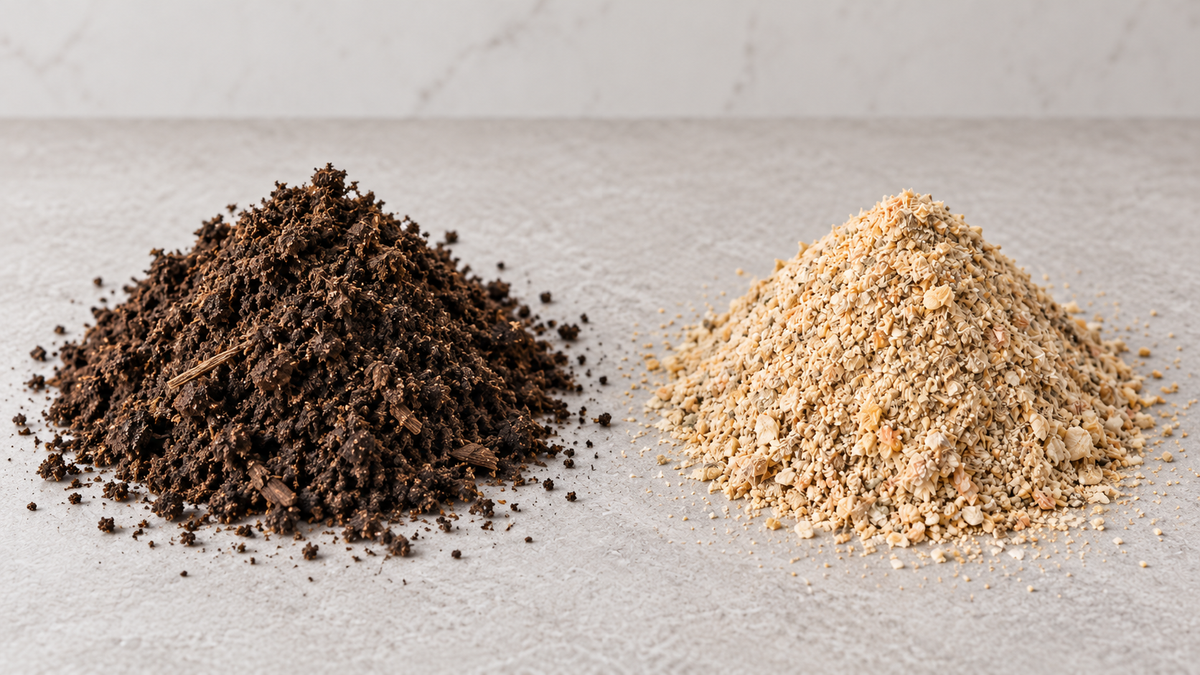
unavoidable kitchen scraps → continuous microbial decomposition → Active Compost Base → soil blending
GEME is built around living biology rather than making dehydration the end of the process.
Suitable scraps from normal cooking can join the active microbial bed throughout the day instead of waiting for isolated batch cycles.
GEME brings managed composting indoors for homes where outdoor space, weather, pests or daily pile maintenance make traditional composting difficult.
Harvested Compost Base can be screened and blended with plain soil at approximately 1:8, with further maturation where appropriate.
Terra 2 and GEME Pro use permanent odor-control technology rather than scheduled disposable activated-carbon odor filters.
Terra 2 covers typical 1–3 person households; GEME Pro gives larger families substantially more daily processing headroom.
For the dedicated product-solution argument rather than repeating it here, continue to:
5 Reasons to Compost Food Waste at Home With GEME → Landfill diversion, soil return, daily convenience, filter-free odor control and the complete GEME household food-waste routine.If you want to understand why GEME belongs to a different category from dryer-style kitchen appliances, read What Is an Electric Composter?.
11. GEME Terra 2 or GEME Pro?
| Household Need | GEME Terra 2 | GEME Pro |
|---|---|---|
| Best fit | 1–3 people | 4+ people / heavier cooking |
| Active chamber | 14 L | 19 L |
| Daily guidance | Up to 2 kg/day | Up to 5 kg/day |
| Processing model | Continuous aerobic microbial processing | Continuous aerobic microbial processing |
| Routine replacement odor filter | None | None |
| Output pathway | Active Compost Base → soil blending | Active Compost Base → soil blending |
Prevent First · Compost What Remains
Give Unavoidable Kitchen Waste a Biological Path Back Toward Soil
GEME Terra 2 and GEME Pro turn the final stage of household food-waste management into continuous microbial composting instead of another dry-waste disposal step.
12. Explore the Complete Food Waste Topic Cluster
This page defines the topic. Use the deeper guides below for the specific question you are trying to answer.
Frequently Asked Questions
What is food waste?
Food waste is edible food and food-derived material that is not ultimately eaten. At household level, it includes avoidable edible waste such as spoiled groceries and leftovers, plus unavoidable preparation scraps such as peels, trimmings and coffee grounds.
What is the difference between food waste and food loss?
Food loss generally occurs earlier in the supply chain during production, post-harvest handling, storage, transport and processing. Food waste usually refers to food discarded at retail, food-service and household stages.
What causes most household food waste?
Common causes include overbuying, poor storage, forgotten ingredients, oversized portions, unused leftovers, date-label confusion and having no plan for surplus food before it spoils.
How can I reduce food waste?
Check what you already have before shopping, buy realistic quantities, plan meals around perishable ingredients, store food correctly, keep leftovers visible, freeze surplus early and compost suitable unavoidable scraps only after edible food has been saved wherever practical.
Why is food waste bad for the environment?
Edible food already carries resource use from farming, water, energy, processing, refrigeration, packaging and transport. If it is then landfilled, food can also decompose under low-oxygen conditions and contribute to methane emissions.
What happens to food waste after it is thrown away?
Depending on the local system, food waste may go to landfill, incineration, wastewater treatment, anaerobic digestion, municipal composting, food recycling or a household composting system. These pathways have different effects on carbon, nutrients and soil return.
Is composting a food waste solution?
Yes, for suitable unavoidable scraps. Composting uses microorganisms to biologically break down organic materials and creates a route for organic matter and nutrients to return toward soil.
Should edible food be composted?
Prevent edible food waste whenever safely possible. Eating, storing, freezing, repurposing or donating edible food preserves more of the resources already invested in producing it. Composting is a later pathway for suitable scraps that cannot reasonably be eaten.
How does GEME help with food waste?
GEME provides an indoor continuous microbial pathway for suitable unavoidable kitchen scraps. Terra 2 and GEME Pro use Kobold living microbes and managed aerobic conditions rather than simply drying and grinding food waste.
What is the difference between GEME Terra 2 and GEME Pro?
Terra 2 has a 14 L chamber and is designed primarily for 1–3 person households with up to approximately 2 kg of daily food-waste processing. GEME Pro has a 19 L chamber and supports up to approximately 5 kg per day for larger households of four or more people and heavier cooking routines.
Is food waste connected to climate change?
Yes. Wasted food carries emissions associated with production, processing, refrigeration and transport. Food waste sent to landfill can also generate methane as it decomposes under low-oxygen conditions.
What is the best food waste solution?
The best solution is a hierarchy rather than a single product: prevent edible waste first, store and use food better, freeze or repurpose surplus, and compost suitable unavoidable scraps through an appropriate biological pathway.
Authoritative Sources
- UNEP — Food Waste Index Report 2024
- U.S. EPA — Wasted Food Scale
- U.S. EPA — Preventing Wasted Food at Home
- U.S. EPA — Composting
- USDA FSIS — Food Product Dating
- GEME — Food Waste Statistics 2026
- GEME — How to Reduce Food Waste at Home
- GEME — Food Storage & Waste Reduction Guide
- GEME — What Happens to Food Waste After You Throw It Away?
- GEME — Complete Home Composting Guide


Commenta
Nota che i commenti devono essere approvati prima di essere pubblicati.
Questo sito è protetto da hCaptcha e applica le Norme sulla privacy e i Termini di servizio di hCaptcha.