
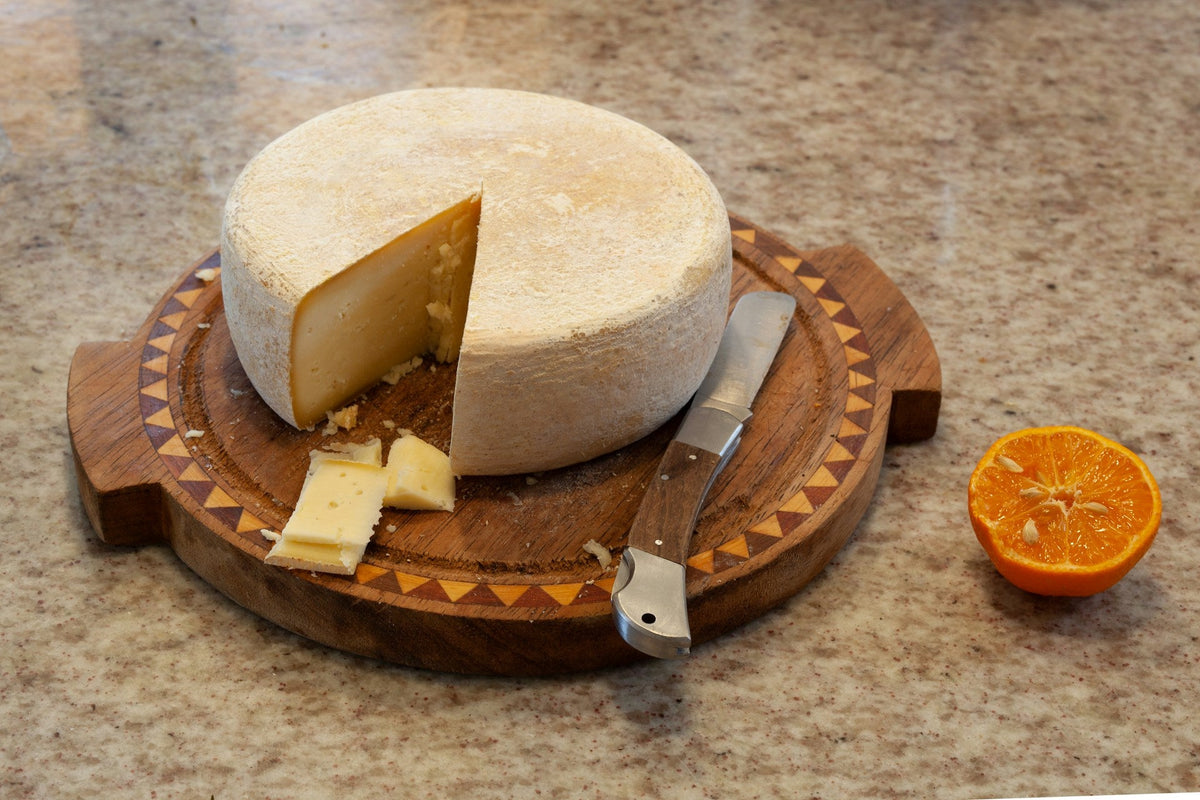
Food Storage · Cheese Safety · Composting
How long cheese lasts, whether it is still safe to eat, and whether it can be composted are three different questions.
That distinction matters. An opened block of Cheddar may keep for weeks. A soft cheese may have a much shorter refrigerator window. And if unexpected mold makes a cheese unsuitable for eating, that does not suddenly make the organic material non-compostable.
As a general U.S. refrigerator guideline, opened hard cheeses such as Cheddar, Swiss, and Parmesan can keep about 3–4 weeks. Soft cheeses such as cottage cheese, ricotta, and Brie are closer to 1 week. Keep refrigerated cheese at 40°F / 4°C or below.
If unexpected mold appears, the food-safety decision depends on the cheese. A solid hard cheese may be salvageable by cutting away at least 1 inch around and below the mold. Soft, shredded, sliced, and crumbled cheeses should generally no longer be eaten when unexpected mold appears.
But “do not eat” is not the same as “cannot compost.” If cheese is no longer suitable as food, it can still enter an appropriate composting system that accepts dairy. GEME Terra 2 and GEME Pro accept cheese and dairy scraps.

Quick Answer: How Long Does Cheese Last and What Happens After That?
How long can this type of cheese reasonably stay refrigerated?
Hard cheese generally lasts much longer than high-moisture soft cheese.
Is this cheese still appropriate to eat?
Unexpected mold on soft cheese can make the entire cheese unsuitable for eating, while localized mold on a hard block can often be trimmed away.
If it should not be eaten, is the cheese still compostable?
Yes, in a composting system that accepts dairy. GEME accepts cheese and dairy scraps.
The correct sequence is: store it correctly → decide whether it is still edible → if it is no longer food, choose the correct organic-waste route.
1. Storage, Eating Safety, and Composting Are Three Different Decisions
This is the most important idea in the entire guide.
When people ask whether cheese has “gone bad,” they often mix three completely different questions.
Question A: How Long Has It Been Stored?
This is a food-storage question. It depends on the type of cheese, refrigeration temperature, whether the package is open, and the product's specific instructions.
Question B: Is It Still Appropriate to Eat?
This is a food-safety question. Mold, unsafe temperature history, contamination, packaging problems, or other warning signs may remove the cheese from the food stream.
Question C: If I Shouldn't Eat It, Can I Compost It?
This is a composting-system question. A food-safety decision not to eat cheese does not change the fact that cheese is biodegradable organic material. What matters now is whether your composting method accepts dairy.
Not safe or suitable to eat ≠ not compostable.
That distinction prevents an important food-waste mistake: interpreting every official instruction to “discard” food as an instruction that the organic material must go to landfill.
2. How Long Does Cheese Last in the Fridge?
There is no single refrigerator lifetime for “cheese.”
| Cheese Type | Examples | General Refrigerator Guidance | If Unexpected Mold Appears | Can the Inedible Cheese Still Be Composted? |
|---|---|---|---|---|
| Hard cheese | Cheddar, Swiss, block Parmesan | About 3–4 weeks after opening | Trim at least 1 inch around and below localized mold | Yes, in a system that accepts dairy |
| Soft cheese | Ricotta, cottage cheese, cream cheese, Brie | About 1 week for many soft cheeses | Do not eat if unexpected mold appears | Yes, in a system that accepts dairy |
| Shredded, sliced, or crumbled cheese | Shredded Cheddar, sliced cheese, crumbled feta | Follow package instructions after opening | Do not eat if mold appears | Yes, in a system that accepts dairy |
| Mold-ripened cheese | Brie, Camembert, blue cheese, Gorgonzola, Stilton | Depends on cheese and package guidance | Distinguish intended cheesemaking mold from unexpected mold | Yes, if it becomes inedible |
Keep refrigerated cheese at 40°F / 4°C or below.
The storage window helps you plan when to eat a product. It does not answer every later composting question.
3. How Long Does Hard Cheese Last?
Hard cheeses generally have a longer refrigerated life because they contain less available moisture than soft cheeses.
USDA general guidance lists hard cheeses such as:
- Cheddar;
- Swiss;
- Parmesan
at about 3–4 weeks after opening in the refrigerator.
Before opening, USDA's general reference gives hard cheese up to about 6 months refrigerated.
Use the Opening Date, Not Your Memory
Write “Opened 9/18” on the package or container. A simple opening date makes a multi-week food much easier to manage.
4. How Long Does Soft Cheese Last?
Soft cheeses generally have a much shorter storage life.
USDA's general refrigerator guidance gives approximately 1 week for soft cheeses such as:
- cottage cheese;
- ricotta;
- Brie.
Because these foods contain more moisture, they should not be managed as though they were blocks of aged Cheddar.
Use Soft Cheese First
If your refrigerator contains opened ricotta and opened Parmesan, the ricotta belongs in your “Eat First” plan. The two foods do not have the same storage clock.
For a broader first-in, first-out refrigerator system, read How to Organize Your Fridge to Reduce Food Waste.

5. If Cheese Has Mold, Can You Still Eat It?
This section is only about whether the cheese should still be eaten.
It is not a compostability judgment.
Hard Block Cheese
For a solid hard cheese such as Cheddar, USDA says localized unexpected mold can be removed.
Cut at least:
- 1 inch around the mold;
- 1 inch below the mold.
Keep the knife out of the mold itself so you do not drag mold into the portion you intend to keep.
Then rewrap the remaining cheese in fresh wrapping.
Soft Cheese
If unexpected mold appears on a soft cheese such as cottage cheese, cream cheese, chèvre, or similar high-moisture cheese, USDA says the cheese should no longer be eaten.
This is a food-safety decision.
It does not mean the organic material is no longer biodegradable.
Shredded, Sliced, and Crumbled Cheese
USDA also recommends removing these products from the food stream when mold appears.
Do not simply pull out the visibly moldy pieces and eat the rest.
Important: “Discard” Here Means Do Not Eat
Food-safety guidance commonly uses the word discard.
In this article, whenever USDA guidance says a moldy cheese should be discarded, we mean discard it as edible food. The next question is whether the organic material can go to an appropriate composting system.
6. Can Moldy Cheese Be Composted?
Yes, if the composting system accepts dairy.
Visible mold does not transform cheese from organic material into a non-compostable substance.
Once you have decided that a cheese should no longer be eaten, you are dealing with an organic-waste decision rather than a food-safety decision.
Moldy Cheese Can Go Into GEME
GEME Terra 2 and GEME Pro accept cheese and dairy food scraps.
So if ricotta, cream cheese, Brie, shredded cheese, or another cheese is no longer appropriate to eat because of unexpected mold:
- stop treating it as edible food;
- remove plastic film, foil, tubs, wrappers, labels, or other non-food packaging;
- put the cheese itself into GEME.
The mold is a reason not to eat the cheese. It is not a reason to send the cheese to landfill.
What About the Mold Itself?
Mold is fungal growth on organic material.
The presence of mold changes the food-safety judgment because mold may extend below the visible surface and some moldy foods may also contain bacterial growth.
But once the material is no longer being considered for human consumption, that food-safety concern does not make the organic cheese inherently unsuitable for biological decomposition in a system designed to accept dairy.
7. Backyard Compost vs Municipal Compost vs GEME
The correct composting answer depends on the system.
| Method | Cheese / Dairy? | Moldy Cheese? | Main Reason |
|---|---|---|---|
| Basic backyard pile | Generally not recommended | Generally not recommended | Dairy can attract animals, create odor, and may not break down well in ordinary backyard conditions |
| Commercial / municipal compost | Often accepted | Often accepted | Facilities may handle a broader food-waste stream; local rules vary |
| GEME Terra 2 / Pro | Yes | Yes | Cheese and dairy are suitable inputs for the managed continuous microbial system |
EPA advises ordinary backyard composters to avoid cheese and dairy mainly because these foods can attract animals and because typical backyard piles may not achieve conditions needed to handle them effectively.
That should not be rewritten as: “cheese cannot be composted.”
The accurate statement is:
Cheese is compostable organic material, but not every composting method is designed to accept dairy.
8. What About Brie, Camembert, and Blue Cheese?
Some cheeses are intentionally made with mold.
Examples include:
- Brie;
- Camembert;
- Roquefort;
- blue cheese;
- Gorgonzola;
- Stilton.
The characteristic white rind on Brie and Camembert or blue-green veins in blue cheese can be a normal part of cheesemaking.
That manufacturing mold is not the same as unexpected spoilage mold.
Expected Mold vs Unexpected Mold
A normal white Brie rind does not mean the cheese is spoiled.
But if a soft mold-ripened cheese develops a different mold that is not part of the manufacturing process, USDA recommends removing that cheese from the food stream.
Again, removing it from the food stream does not prevent the cheese from being composted afterward.
9. How Should You Store Cheese After Opening?
Keep the Refrigerator at 40°F / 4°C or Below
FDA recommends keeping the refrigerator at or below 40°F / 4°C.
Cover the Cheese
Reseal the original package well or use a suitable clean food-storage container.
Leaving an opened block, wedge, or tub exposed increases quality loss and the opportunity for contamination.
Use Clean Utensils
For spreadable cheese, ricotta, cottage cheese, and similar products, avoid repeatedly introducing crumbs or food residue with used utensils.
Label the Opening Date
An opening date is often more useful than trying to remember when the package was first used.
Create an “Eat First” Zone
Prioritize:
- opened soft cheese;
- foods close to the end of their practical refrigerator window;
- small remaining portions;
- ingredients already planned for upcoming meals.
The broader system is covered in Food Storage Guide: Keep Food Fresh & Reduce Waste.
10. Does the Date on the Package Mean the Cheese Is Bad?
Not automatically.
For many U.S. foods, labels such as:
- Best By;
- Best if Used By;
- Sell By;
- Use By
do not all mean the same thing.
A cheese decision should consider:
- the type of cheese;
- whether it has been opened;
- package-specific instructions;
- refrigerator temperature;
- storage history;
- and signs of spoilage.
Read the full guide: Food Expiration Dates: Best By, Sell By, and Use By.
11. Can You Freeze Cheese?
Yes, especially hard cheese.
USDA's general quality guidance gives hard cheese about 6 months in the freezer.
Freezing may change texture, so previously frozen cheese is often especially useful for:
- sauces;
- soups;
- pasta;
- casseroles;
- baking;
- melting.
Many soft cheeses do not freeze particularly well because thawing can alter their texture.
Prevent Waste Before It Happens
If you know a large block of hard cheese will not be used in time, freezing part of it while it is still good preserves more value than waiting for it to spoil and then composting it.
12. What Happens When Cheese Becomes Food Waste?
Food-waste prevention should come first.
As long as the cheese is safe and suitable to eat:
Store → Eat → Repurpose → Freeze.
But there comes a point where a food-safety decision removes a cheese from the food stream.
At that point, the sequence changes:
No longer edible → remove packaging → GEME → continuous microbial processing.
GEME Separates “Food Safety” From “Organic Recovery”
If an opened tub of ricotta develops unexpected mold, the correct food-safety decision is: do not eat it.
The correct GEME decision can still be: remove the tub and lid, then put the cheese into GEME.
If shredded cheese develops mold, the correct food-safety decision is: do not eat the remaining bag.
The correct GEME decision can still be: separate the cheese from its plastic packaging and biologically process the cheese.
Unsafe to eat does not mean biologically useless.
Why This Matters for Dairy Waste
Ordinary backyard composting guidance commonly excludes dairy because unmanaged piles may create odor and attract animals.
GEME uses a different household workflow.
Terra 2 and GEME Pro maintain a continuous aerobic microbial environment for suitable food scraps, while PermaFilter™ provides odor treatment without routine disposable activated-carbon filter replacement.
That means cheese does not need to remain in a trash bag simply because it has left the human food stream.
What Should Be Removed First?
Only the non-food material:
- plastic wrappers;
- film;
- foil;
- wax or packaging where applicable;
- plastic tubs;
- labels and other non-food components.
The cheese itself, including moldy cheese that is no longer edible, can go into GEME.
For the broader feedstock guide, see What Can You Compost at Home?.
Don't Confuse “Don't Eat It” With “Throw It in the Trash.”
Cheese has three separate decision points.
Storage: How long has this type of cheese been refrigerated?
Eating: Is it still appropriate to consume?
Composting: If it is no longer food, can its organic material still be recovered?
For cheese and dairy, GEME makes that final step simple.
Eat it while it is good. If it becomes inedible, remove the packaging and return the organic material to the biological cycle.
Frequently Asked Questions
How long does cheese last in the fridge?
It depends on the type. USDA general guidance gives opened hard cheeses such as Cheddar, Swiss, and Parmesan about 3–4 weeks refrigerated, while many soft cheeses such as cottage cheese, ricotta, and Brie are closer to 1 week.
How long does cheese last after opening?
Hard cheese generally has a much longer opened refrigerator life than soft cheese. USDA gives opened hard cheeses about 3–4 weeks and many soft cheeses about 1 week.
How cold should the refrigerator be for cheese?
Keep refrigerated cheese at 40°F / 4°C or below.
How long does Cheddar last after opening?
USDA's general guidance for opened hard cheese such as Cheddar is about 3–4 weeks in the refrigerator.
How long does Parmesan last after opening?
Block Parmesan falls within USDA's hard-cheese category, with a general refrigerated storage guideline of about 3–4 weeks after opening.
How long does ricotta last in the refrigerator?
USDA places ricotta in the soft-cheese category and gives a general refrigerated storage period of about 1 week.
How long does Brie last in the refrigerator?
USDA includes Brie in its general soft-cheese guidance of about 1 week refrigerated. More specific package guidance should also be followed.
Can you cut mold off Cheddar cheese?
Yes, if it is a solid hard block. USDA recommends cutting at least 1 inch around and below the mold spot while keeping the knife out of the mold itself.
Can you cut mold off soft cheese?
No. If unexpected mold appears on a soft cheese, USDA recommends that it no longer be eaten because contamination can extend below the visible surface.
Can you eat moldy shredded cheese after removing the moldy pieces?
No. USDA recommends that shredded, sliced, and crumbled cheese with unexpected mold no longer be eaten rather than removing only the visible mold.
Does “discard moldy cheese” mean it cannot be composted?
No. In food-safety guidance, discarding moldy cheese means it should no longer be eaten. Compostability is a separate question. Cheese can still be biologically processed in a composting system that accepts dairy.
Can moldy cheese be composted?
Yes, in a composting system that accepts dairy. Visible mold may make certain cheeses unsuitable for eating, but it does not make the organic material non-compostable.
Can moldy cheese go into GEME Terra 2?
Yes. If cheese is no longer suitable to eat, remove non-food packaging and the cheese itself can go into GEME Terra 2, including cheese with visible mold.
Can moldy cheese go into GEME Pro?
Yes. GEME Pro also accepts cheese and dairy food scraps. Remove the packaging and add the organic cheese portion to the normal food-waste stream.
Can cheese go in backyard compost?
Cheese is biodegradable, but EPA recommends avoiding dairy in ordinary backyard compost piles because it can attract animals and typical backyard conditions may not break it down effectively.
Can cheese be commercially composted?
Yes, many commercial composting facilities can process materials such as dairy that are not recommended for basic backyard composting. Acceptance rules vary by facility, so check the local program.
Is mold on Brie normal?
The characteristic white surface mold on Brie is intentionally used during cheesemaking and is normal. Unexpected mold that is not part of the manufacturing process is a different food-safety issue.
Is blue mold in blue cheese supposed to be there?
Yes. The mold intentionally used to produce cheeses such as Roquefort, blue cheese, Gorgonzola, and Stilton is part of the product.
Can you freeze cheese?
Yes, particularly hard cheese. USDA gives hard cheese about 6 months of freezer storage for quality, although freezing may change texture.
Can cheese that is past its Best By date still be eaten?
A Best By date does not by itself answer the safety question. Consider the type of cheese, opening date, package instructions, temperature history, storage conditions, and signs of spoilage.
Can spoiled cheese go into GEME?
Yes. Once cheese is no longer appropriate to eat, remove its non-food packaging and the organic cheese can be processed in GEME Terra 2 or GEME Pro.
Can dairy go into GEME?
Yes. Cheese and other suitable dairy food scraps can be included in the normal GEME household food-waste stream.
Sources
- USDA FSIS — How Long Can You Keep Dairy Products Like Yogurt, Milk, and Cheese in the Refrigerator?
- USDA FSIS — Molds on Food: Are They Dangerous?
- USDA FSIS — Are Molds Used to Make Cheese?
- FDA — Are You Storing Food Safely?
- FDA — Queso Fresco-Type Cheeses Consumer Guidance
- U.S. EPA — Composting at Home
- GEME — Food Storage Guide
- GEME — Food Expiration Dates: Best By, Sell By, and Use By
- GEME — How to Organize Your Fridge to Reduce Food Waste
- GEME — What Can You Compost at Home?


Commenta
Nota che i commenti devono essere approvati prima di essere pubblicati.
Questo sito è protetto da hCaptcha e applica le Norme sulla privacy e i Termini di servizio di hCaptcha.